Kategori: DNA-Encoded Libraries (DEL)

Structural Proteins as Drug Targets

Structural Proteins as Drug Targets: In-Cell DEL Screening for Oncology Programs

Get In Touch

Structural proteins sit at the heart of cancer cell biology. They build the cytoskeleton (microtubules, actin filaments, intermediate filaments), organize the mitotic spindle, shape membranes, and coordinate transport, polarity, invasion in cancer, and survival. Because these systems are essential for proliferation and metastasis, they have also produced some of the most durable drug classes in oncology, especially microtubule-targeting agents used across solid tumors and hematological malignancies [1], [2].

At the same time, “structural protein drug discovery” has historically come with tradeoffs: narrow therapeutic windows, complex cellular context, and targets that are dynamic, polymeric, and highly conserved. These challenges are why many cytoskeletal drug targets still rely on legacy chemotypes or phenotypic screening hits, rather than modern, binding-driven campaigns. Yet the last decade has brought a major shift in what is possible: improved structural biology (cryo-EM of polymeric complexes), better in-cell target engagement assays, and DNA-encoded library (DEL) methods that can generate binders for hard-to-drug proteins, including in living cells.

This article maps the opportunity landscape for cytoskeleton drug targets (with emphasis on microtubule ligand discovery and antimitotic programs), outlines why structural proteins are “binding-driven targets” despite their reputation, and explains how DNA encoded library oncology screening (including in-cell approaches) can complement (and de-risk) traditional phenotypic screening.

Structural Proteins in Cellular Architecture

Structural proteins are often described as “scaffolding,” but in cancer biology they are better understood as adaptive machines. They remodel in seconds, respond to force, and integrate signaling and metabolism. That dynamism is precisely what makes them attractive, albeit difficult drug targets.

Cytoskeletal Dynamics

The cytoskeleton is not one system; it is a coordinated network:

  • Microtubules: polarized polymers of α/β-tubulin that form tracks for kinesin/dynein transport, organize organelles, and build the mitotic spindle.
  • Actin filaments: rapidly assembling networks that generate force for migration, cytokinesis, and membrane remodeling.
  • Intermediate filaments: stress-bearing polymers (e.g., vimentin, keratins) that provide mechanical resilience and influence signaling states.

Crosstalk between actin and microtubules is central to migration and division and provides multiple intervention points beyond “direct tubulin binders” [3]. Natural products have historically been a key source of cytoskeletal probes and drugs, highlighting that these proteins are chemically addressable even when they appear “flat” in simplified models [4].

Role in Cell Division and Survival

Cytoskeletal proteins become most targetable in oncology when one connects them to vulnerabilities:

  • Mitosis and chromosomal instability: spindle assembly, microtubule dynamics, and checkpoint timing are sensitive to small changes in polymer behavior – one reason antimitotic drug discovery continues to evolve [1], [2].
  • Metastasis and invasion: actin remodeling, adhesion turnover, and intermediate filament switching (e.g., vimentin upregulation) are connected to Epithelial–Mesenchymal Transition (EMT)-like programs and aggressive phenotypes [3], [7].
  • Stress tolerance: intermediate filaments buffer mechanical stress and influence organelle positioning; their dysregulation links to human disease and cancer biology [6].

The key takeaway for drug hunters: structural proteins are essential, but their essentiality is conditional; cell type, state, microenvironment, and genetic background matter. That is both the risk and the opportunity.

Structural Protein Targets Accessible in Cells

When people say, “structural proteins,” they often mean tubulin and actin. In practice, oncology-relevant “structural protein targets” span: polymers (tubulin/actin), polymer regulators, spindle machinery, and cytoskeleton-associated complexes.

Microtubules

Microtubules remain the flagship example of a structural protein drug target class. Multiple binding sites on tubulin enable stabilizers and destabilizers, and clinically validated mechanisms include both mitotic arrest and non-mitotic effects on trafficking, signaling, and tumor vasculature [1], [2].

What’s changing now is not the importance of tubulin, but the precision with which we can define where and how a ligand binds:

  • Structural methods have mapped canonical sites (taxane, vinca alkaloids, colchicine, etc. [Scheme 1]) and revealed how distinct ligands tune microtubule dynamics [22]–[24].
  • The “tubulin code” – isotypes and post-translational modifications – adds layers of biological selectivity that can be exploited for context-specific targeting and safety [21].

Scheme 1: Structure of different tubulin ligands.

From program-design perspective, this is where microtubule ligand discovery becomes more than “find another tubulin poison.” The frontier is selective modulation: isoform bias, complex-specific binding, or allosteric control of partner proteins.

Mitotic Spindle Components

“Antimitotic drug discovery” is broader than tubulin. Many programs target spindle machinery indirectly:

  • Motor proteins (e.g., kinesins such as Eg5/KIF11)
  • Microtubule-associated proteins (MAPs)
  • Spindle assembly and checkpoint regulators
  • Protein–protein interactions (PPIs) within dynamic mitotic complexes

A classic example is the discovery of monastrol, a small molecule that perturbs spindle bipolarity by inhibiting the kinesin Eg5 – an early demonstration that mitotic machinery can yield tractable small-molecule binders even outside tubulin [25].

Beyond Tubulin: Actin and Intermediate Filaments

Actin is deeply implicated in invasion and survival, but direct actin targeting has been limited clinically by toxicity. A major strategy is to target actin regulators (e.g., tropomyosins and nucleation factors), rather than the core polymer [5]. Intermediate filaments are less explored but increasingly recognized as druggable via indirect mechanisms (disrupting assembly, targeting associated kinases, or exploiting cancer-specific dependencies). Their disease links and mechanistic roles are well established [6], and vimentin’s role in cancer phenotypes makes it a frequent point of interest [7].

Drug Discovery Challenges

Structural proteins generate three recurring challenges that directly impact hit discovery and lead optimization.

Balancing Potency and Cellular Toxicity

For essential cellular machines, potency is easy to achieve and hard to use safely. This is one reason microtubule drugs can be effective yet limited by neuropathy or myelosuppression, and why actin-directed approaches can be constrained by cardio-toxicity risks [2], [5].

Practical implications for discovery teams:

  • Avoiding “global polymer poisons”: prioritize modulators that bias specific states, complexes, or cell contexts.
  • Separating binding from catastrophic function loss: not every binder must be a strong destabilizer; some can be allosteric modulators or complex stabilizers.

Early safety triage: structural proteins demand early counterscreens and cellular selectivity analysis, not late-stage “surprises.”

Context-Specific Target Engagement

Structural proteins are dynamic and compartmentalized. The “same” protein can exist in multiple functional forms:

  • Soluble monomer/dimer pools vs polymerized filaments
  • Distinct complexes with partner proteins
  • Isoforms and post-translational modification (PTM)-defined subpopulations (notably for tubulin) [21]

That means a binder found against purified protein may not engage the relevant cellular state. This is where protein binding site identification and in-cell target engagement become central – not optional.

Two widely used families of approaches are:

  • CETSA (Cellular Thermal Shift Assay) to measure stabilization of proteins upon ligand binding in cells/tissues [19]
  • Thermal proteome profiling (TPP) to assess proteome-wide engagement and downstream effects in living cells [20]

These methods don’t replace functional assays, but they reduce ambiguity early especially when structural proteins generate complex phenotypes.

Protein Binding Site Identification for Structural Proteins

Structural protein drug discovery increasingly depends on identifying which pocket (or interface) matters biologically.

Why “Structural” Doesn’t Mean “Undruggable”

A misconception is that structural proteins lack binding pockets. In reality, they often offer:

  • Interfacial pockets (between subunits or protein partners)
  • Conformation-specific cavities (open only in certain states)
  • Polymer-specific surfaces (present only in filaments)
  • Allosteric sites that tune dynamics rather than block an active site

Tubulin illustrates this best: decades of work have mapped major small-molecule sites and explained how different ligands stabilize or destabilize microtubules [22]–[24]. The emerging frontier is expanding beyond “the usual sites” and leveraging complex-dependent pockets.

A recent example: a newly defined tubulin ligand-binding site

A compelling recent study reported a previously unknown tubulin ligand-binding site that only emerges in the context of a tubulin complex with the stathmin family protein RB3 and tubulin tyrosine ligase (TTL) [26]. The authors show that Tumabulin-1 (TM1, Scheme 2), derived from BML284, can bind not only the canonical colchicine site but also a second site located at an interface involving α/β-tubulin plus RB3. Strikingly, two TM1 molecules bind cooperatively in this relatively large pocket, contacting multiple proteins in the complex. The work goes further by designing Tumabulin-2 (TM2, Scheme 2), a derivative engineered to bind selectively to this newly described “Tumabulin site” rather than the colchicine site. Functionally, TM2 behaves as a molecular glue: it strengthens the interaction between RB3 and tubulin, enhances RB3’s tubulin-depolymerizing activity, and supports the idea that “complex-first” pockets can be exploited to create new antimitotic mechanisms. Conceptually, this is a blueprint for future microtubule ligand discovery: instead of only targeting tubulin in isolation, drug discovery can aim at partner-dependent binding sites that may offer more selective biology and new safety/efficacy tradeoffs.

Scheme 2: Structure of TM1 and TM2

Structural Proteins as Binding-Driven Targets

Structural proteins are often discovered via phenotypic effects (mitotic arrest, migration block). But that doesn’t mean they are “phenotype-only” targets. They are profoundly binding-driven:

  • A small change in microtubule catastrophe frequency can shift mitotic outcomes [1], [2]
  • Stabilizing or destabilizing specific actin architectures can alter cancer invasion programs [3], [5]
  • Modulating complex formation (molecular glue mechanisms) can create new functional outputs [26]

This is the bridge to DEL: DEL screening is best when binding is the primary signal and when rapid exploration of chemical space is wanted to find rare chemotypes that can engage challenging pockets [11], [12].

In-Cell DEL Screening for Structural Proteins

Why in-cell approaches matter for cytoskeleton drug targets

Structural proteins are context-dependent; many relevant binding sites are:

  • conformation-specific,
  • complex-dependent,
  • influenced by PTMs/isoforms,
  • or only present in living-cell conditions.

In-cell approaches reduce the risk of selecting binders that only recognize an artificial purified state.

What DEL is (and why it’s relevant here)

DNA-encoded libraries link each small molecule to a DNA barcode so billions of compounds can be pooled, selected for binding, and decoded by sequencing. The foundational concept of encoding chemistry with amplifiable information dates back to early encoded combinatorial chemistry [10], and has since matured into a widely used hit-finding engine [11]. Modern reviews cover selection formats, library design, artifacts, and translation to medicinal chemistry [12], [13].

Evidence base for DEL screening on or in living cells

Several peer-reviewed studies established that DEL selections can be done in living-cell contexts, including on-cell-surface targets and intracellular environments:

  • DEL selection within and on living cells using cell-penetrating approaches [14]
  • DEL screening inside a living cell using Xenopus laevis oocytes as a cellular “reaction vessel” [15]
  • DEL selection against endogenous membrane proteins on live cells, supporting native-context binder discovery without purified target [16]

For structural proteins and cytoskeleton-associated complexes, these approaches are attractive because they better preserve polymer states, native assemblies, and cellular competition effects – key determinants of “real” engagement.

DEL screening directly in living cells

Vipergen has described service and technology approaches that emphasize DEL screening from target binding through hit validation, including screening formats designed for living-cell contexts and difficult targets [17]. Vipergen also offers a “Molecular Glue Direct” DELs-in-cells format intended to discover molecular glues by co-expressing targets and interaction partners (including E3 ligases) and screening in a multiplexed format in living cells [18]. For structural proteins, this matters because complex-dependent pockets (like the Tumabulin site example above) are often the most compelling places to look – but they are also the easiest to miss in simplified assays.

DEL Workflow and Applications for Oncology Programs

1) Define the structural target hypothesis (binder-first)

For cytoskeleton drug targets, the hypothesis is usually one of these:

  1. Polymer modulation: tune microtubule/actin dynamics without total collapse
  2. Complex modulation: target a partner-dependent interface pocket (e.g., tubulin-RB3-like concepts)
  3. Spindle machinery inhibition: block a motor protein or mitotic complex assembly
  4. Selectivity-by-context: exploit isoforms/PTMs/complexes that differ between tumor and normal tissues [21]

In practical terms: The question is not only asking “can we inhibit this?” but “which binding event produces the oncology-relevant phenotype with acceptable safety?”

2) Choose the selection environment: in vitro vs in-cell

  • In vitro DEL screening can be ideal when stable purified protein is easily accessible, tight control is wanted and can fold into the relevant conformation.
  • In-cell DEL screening becomes especially valuable when:
    • The target is hard to purify
    • The relevant binding site is complex-dependent
    • Post-translational modifications matter,
    • Early evidence of cellular relevance is wanted [14-16].

For cytoskeleton targets, in-cell approaches can also help filter out compounds that bind the purified protein but cannot compete with endogenous binding partners or fail due to localization barriers.

3) Run a selection designed to reduce “structural protein artifacts”

Structural proteins are abundant and sticky; selections must be designed to reduce frequent hitters and nonspecific binders. Typical design principles include:

  • Multiple negative selections (beads/DNA controls; off-target protein controls)
  • Competition experiments with known ligands (when available)
  • Orthogonal selection conditions (salt, detergents compatible with target state, polymer vs monomer conditions)
  • Early clustering and “chemical series” prioritization rather than singletons

The point is not to eliminate all noise, it’s to quickly surface chemotypes that behave consistently across selection variants.

4) Translate hits off-DNA and validate binding

DEL delivers hypotheses; medicinal chemistry needs confirmed molecules. Typical validation includes:

  • Biophysical binding confirmation (MST, SPR, ITC, DSF)
  • Structural follow-up (cryo-EM or X-ray where feasible), particularly important for tubulin sites [22-24]
  • Cellular target engagement:
    • CETSA to confirm in-cell binding [19]
    • TPP to assess proteome-wide engagement and potential liabilities [20]

For structural proteins, engagement data is especially useful because phenotypes can be indirect. Binding confirmation quickly identifies wrong mechanism which can then be eliminated.

5) Functional assays: tune the phenotype, not just potency

For oncology, the functional readouts depend on target class:

  • Microtubules: polymerization dynamics, spindle formation, mitotic timing, aneuploidy signatures
  • Spindle motors: bipolar spindle assembly defects, mitotic arrest phenotypes (monastrol-like patterns) [25]
  • Actin systems: migration/invasion assays, adhesion turnover, cytokinesis defects [3], [5]
  • Complex-dependent targets: specific biomarker readouts tied to complex stabilization/destabilization (as in molecular glue concepts) [26]

A practical strategy is to start with a binder series, then intentionally explore the “phenotype space” by tuning permeability, residence time, and allosteric bias – rather than pushing raw potency immediately.

Positioning Against Phenotypic Screening

Phenotypic screening has historically been productive in cytoskeletal biology – partly because many phenotypes (mitotic arrest, rounded morphology, migration block) are easy to observe. But phenotypic screening also has recurring major bottlenecks and constraints:

  • target deconvolution can be slow,
  • the same phenotype can come from many targets,
  • and off-target toxicity can generate false-positive signals / artifactual activity as “activity.”

Large analyses of discovery strategies have shown that phenotypic approaches have contributed substantially to first-in-class medicines [8], and industry perspectives continue to highlight both opportunity and friction in phenotypic drug discovery [9].

DEL-based discovery offers a complementary angle:

  • DEL is binder-first: Chemical matter is the starting point which can be tied to a target hypothesis.
  • Phenotypic screens are effect-first: Phenotype is the starting point and search for mechanism is the later work.

For structural proteins, a hybrid approach is often best:

  1. use binding-driven DEL screening to generate selective chemotypes for a structural target or complex,
  2. then test those chemotypes across phenotypic systems (cell division, migration, survival),
  3. while using target engagement tools (CETSA/TPP) to confirm that cellular biology matches the binding hypothesis [19], [20].

This is especially valuable for modern microtubule ligand discovery, where the goal is not “maximum disruption,” but mechanism-shaped modulation that delivers therapeutic windows.

Practical “High-Intent” Use Cases in Oncology

To align with real search behavior and program decisions, here are common scenarios where DEL screening for structural protein targets is often considered:

Use case A: Replace or differentiate legacy microtubule chemotypes

A team wants microtubule modulation but needs:

  • a new binding site,
  • less neuropathy risk,
  • a differentiated resistance profile,
  • or a complex-dependent mechanism.

The Tumabulin site example shows how new tubulin pockets can emerge in complexes and enable novel mechanisms like molecular glue-like stabilization of protein–protein interactions [26].

Use case B: Move from “antimitotic phenotype” to a defined mitotic target

Phenotypic screens find mitotic arrest hits, but target IDs are unclear. DEL can support a binder-first campaign against a mitotic motor or spindle complex, inspired by precedents like Eg5 inhibition [25].

Use case C: Target migration/invasion without direct actin poisoning

Instead of actin itself, target actin regulators or cross-talk nodes that influence cytoskeletal architecture [3], [5]. DEL can help identify small-molecule binders for proteins that are hard to screen traditionally.

Conclusion: Structural Proteins Are Back – With Better Tools

Structural proteins are no longer “legacy-only” oncology targets. Modern structural biology is exposing new pockets in polymeric complexes [22-24] and even expanding the tubulin site landscape through complex-dependent binding sites and molecular glue concepts [26]. In parallel, target engagement methods like CETSA and TPP reduce ambiguity about what a compound is doing in cells [19], [20], and DEL technologies keep expanding the practical chemical search space for hard-to-drug targets [11-13].

For teams working on structural protein drug discovery, the strategic shift is this: move from “find a toxin” to “find a binder that modulates a defined state or complex in the right cellular context.” That’s where DNA encoded library oncology screening – including in-cell formats – can deliver value: fast hit generation, early selectivity signals, and a clearer line from binding to biology [14]–[18].

References

[1] Jordan M.A., Wilson L., Microtubules as a target for anticancer drugs, Nat. Rev. Cancer (2004), 4, 253–265. https://doi.org/10.1038/nrc1317 

[2] Dumontet C., Jordan M.A., Microtubule-binding agents: a dynamic field of cancer therapeutics, Nat. Rev. Drug Discov. (2010), 9, 790–803. https://doi.org/10.1038/nrd3253 

[3] Dogterom M., Koenderink G.H., Actin–microtubule crosstalk in cell biology, Nat. Rev. Mol. Cell Biol. (2019), 20, 38–54. https://doi.org/10.1038/s41580-018-0067-1

[4] Risinger A.L., Du L., Targeting and extending the eukaryotic druggable genome with natural products: cytoskeletal targets of natural products, Nat. Prod. Rep. (2020), 37, 634–652. https://doi.org/10.1039/C9NP00053D 

[5] Bryce N.S., Hardeman E.C., Gunning P.W., Lock J.G., Chemical biology approaches targeting the actin cytoskeleton through phenotypic screening, Curr. Opin. Chem. Biol. (2019), 51, 40–47. https://doi.org/10.1016/j.cbpa.2019.02.013 

[6] Omary M.B., Coulombe P.A., McLean W.H.I., Intermediate filament proteins and their associated diseases, N. Engl. J. Med. (2004), 351, 2087–2100. https://doi.org/10.1056/NEJMra040319 

[7] Satelli A., Li S., Vimentin in cancer and its potential as a molecular target for cancer therapy, Cell. Mol. Life Sci. (2011), 68, 3033–3046. https://doi.org/10.1007/s00018-011-0735-1 

[8] Swinney D.C., Anthony J., How were new medicines discovered?, Nat. Rev. Drug Discov. (2011), 10, 507–519. https://doi.org/10.1038/nrd3480 

[9] Moffat J.G., Vincent F., Lee J.A., et al., Opportunities and challenges in phenotypic drug discovery: an industry perspective, Nat. Rev. Drug Discov. (2017), 16, 531–543. https://doi.org/10.1038/nrd.2017.111 

[10] Brenner S., Lerner R.A., Encoded combinatorial chemistry, Proc. Natl. Acad. Sci. U.S.A. (1992), 89(12), 5381–5383. https://doi.org/10.1073/pnas.89.12.5381 

[11] Goodnow R.A. Jr., Dumelin C.E., Keefe A.D., DNA-encoded chemistry: enabling the deeper sampling of chemical space, Nat. Rev. Drug Discov. (2017), 16, 131–147. https://doi.org/10.1038/nrd.2016.213 

[12] Neri D., Lerner R.A., DNA-encoded chemical libraries: a selection system based on endowing organic compounds with amplifiable information, Annu. Rev. Biochem. (2018), 87, 479–502. https://doi.org/10.1146/annurev-biochem-062917-012550 

[13] Gironda-Martínez A., Donckele E.J., Samain F., et al., DNA-Encoded Chemical Libraries: A Comprehensive Review with Successful Stories and Future Challenges, ACS Pharmacol. Transl. Sci. (2021), 4(4), 1265–1279. https://doi.org/10.1021/acsptsci.1c00118 

[14] Cai B., Kim D., Akhand, S., et al., Selection of DNA-Encoded Libraries to Protein Targets within and on Living Cells, J. Am. Chem. Soc. (2019), 141(43), 17057–17061. https://doi.org/10.1021/jacs.9b08085 

[15] Petersen L.K., Christensen A.B., Andersen J., et al., Screening of DNA-Encoded Small Molecule Libraries inside a Living Cell, J. Am. Chem. Soc. (2021), 143(7), 2751–2756. https://doi.org/10.1021/jacs.0c09213 

[16] Huang Y., Meng L., Nie Q., et al., Selection of DNA-encoded chemical libraries against endogenous membrane proteins on live cells, Nat. Chem. (2021), 13, 77–88. https://doi.org/10.1038/s41557-020-00605-x 

[17] Vipergen ApS, Understanding DEL Screening: From Target Binding to Hit Validation, Vipergen.com. Link: https://www.vipergen.com/understanding-del-screening-from-target-binding-to-hit-validation/ 

[18] Vipergen ApS, Molecular Glue Screening Service | DELs in Cells – Molecular Glue Direct, Vipergen.com. Link: https://www.vipergen.com/molecular-glue-direct/ 

[19] Molina D. M., Jafari R., Ignatushchenko M., et al., Monitoring Drug Target Engagement in Cells and Tissues Using the Cellular Thermal Shift Assay, Science (2013), 341(6141), 84–87. https://doi.org/10.1126/science.1233606 

[20] Savitski M.M., Reinhard F.B.M., Franken H., et al., Tracking cancer drugs in living cells by thermal profiling of the proteome, Science (2014), 346(6205), 1255784. https://doi.org/10.1126/science.1255784 

[21] Janke C., Magiera M.M., The tubulin code and its role in controlling microtubule properties and functions, Nat. Rev. Mol. Cell Biol. (2020), 21, 307–326. https://doi.org/10.1038/s41580-020-0214-3 

[22] Nogales E., Wolf S.G., Khan I.A., et al., Structure of tubulin at 6.5 Å and location of the taxol-binding site, Nature (1995), 375, 424–427. https://doi.org/10.1038/375424a0 

[23] Ravelli R.B.G., Gigant B., Curmi P.A., et al., Insight into tubulin regulation from a complex with colchicine and a stathmin-like domain, Nature (2004), 428, 198–202. https://doi.org/10.1038/nature02393 

[24] Gigant B., Wang C., Ravelli R.B.G., et al., Structural basis for the regulation of tubulin by vinblastine, Nature (2005), 435, 519–522. https://doi.org/10.1038/nature03566 

[25] Mayer T.U., Kapoor T.M., Haggarty S.J., et al., Small molecule inhibitor of mitotic spindle bipolarity identified in a phenotype-based screen, Science (1999), 286(5441), 971–974. https://doi.org/10.1126/science.286.5441.971 

[26] Li Y., Zhang C., Tang D., et al., Identification of a ligand-binding site on tubulin mediating the tubulin-RB3 interaction, Proc. Natl. Acad. Sci. U.S.A. (2025), 122(11), e2424098122. https://doi.org/10.1073/pnas.2424098122 

Do you have an inquiry?

Contact us today and explore partnership opportunities.

Get In Touch

Related Services

Service
Small molecule drug discovery for even hard-to-drug targets – identify inhibitors, binders and modulators
Molecular Glue Direct
PPI Inhibitor Direct
Integral membrane proteins
Specificity Direct – multiplexed screening of target and anti-targets
Express – optimized for fast turn – around-time
Snap – easy, fast, and affordable

Continue reading

Medicinal Chemistry Services for DNA-Encoded Library Screening

Medicinal Chemistry Services for DNA-Encoded Library Screening

Get In Touch

Introduction

In modern drug discovery, medicinal chemists have more data, more biological targets, and more modalities than ever before. Yet the path from primary screening to validated chemical hits remains a bottleneck for many R&D programs. High-throughput screening, fragment campaigns and DNA Encoded Libraries (DELs) can generate long lists of potential binders, but transforming those signals into experimentally confirmed hits – quickly, reproducible, and with a clear structure activity relationship – demands specialized expertise.

Medicinal chemistry services support the discovery phase where early screening signals are converted into real, testable chemical matter and a clear decision path. For teams seeking outsourced medicinal chemistry support for early drug discovery, our DEL-focused approach delivers validated hit matter and a clear handoff into downstream optimization—whether that work happens in-house or with a medicinal chemistry CRO partner. In a typical workflow, medicinal chemistry helps teams: (1) identify and prioritize hit series, (2) confirm structures with synthesized compounds, and (3) build early structure–activity relationships (SAR) that guide the next optimization steps.

Hit identification can originate from several discovery approaches—such as high-throughput screening (HTS), fragment-based discovery (FBDD), structure-based design (SBDD), or DNA-encoded libraries (DELs). DEL is especially valuable when you want to explore very large chemical space efficiently and quickly translate selection signals into prioritized chemical series for follow-up. On this page, Vipergen’s medicinal chemistry contribution is described with a focus on DEL-enabled hit identification and rapid off-DNA resynthesis/validation—so you can move from sequencing output to decision-ready compounds without losing momentum.

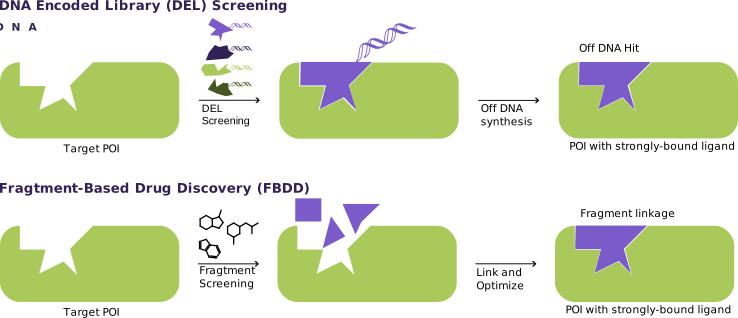
Vipergen was founded to provide exactly that service as a medicinal chemistry company whose platform is built around the synthesis and screening of DELs.  We focus on the initial part of the drug discovery pipeline (figure 1) and can take your target protein of interest (POI) to early lead like compounds in a few months. Hereby Vipergen’s medicinal chemistry platform can help to deliver the greatest impact and the highest return of investment. By concentrating our resources on DEL construction, selections, data analysis, and hit re-synthesis, we offer a streamlined medicinal chemistry service that plugs directly into your discovery engine – no matter whether your downstream chemistry is handled in-house or by another medicinal chemistry CRO. 

Quick definitions: DEL = DNA-encoded library; SAR = structure–activity relationship; NGS = next-generation sequencing; FBDD/SBDD = fragment-/structure-based drug discovery; PPI = protein–protein interaction.

Figure 1: Overview of the drug discovery and development process. Vipergen’s medicinal chemistry services support hit identification and lead identification by combining DEL screening, sequencing/informatics analysis, series nomination, and rapid off-DNA resynthesis—enabling faster confirmation and cleaner handoff into downstream hit-to-lead activities.

Throughout this article we will explain how Vipergen’s focused medicinal chemistry solutions accelerate early drug discovery while maintaining full traceability, uncompromising quality, and competitive turnaround times. We deliver high-quality DEL hits which can readily be resynthesized off-DNA ready for the next phase.

Ready to evaluate DEL for your target? Contact us to discuss target format, selection strategy, and the fastest path to off-DNA validation.

What are Medicinal Chemistry Services?

Medicinal chemistry services help transform early screening signals into validated, optimizable chemical matter. In practice, this means designing and synthesizing compounds, confirming hit structures, building structure–activity relationships (SAR), and improving potency, selectivity, and developability so programs can progress from hitlead efficiently.

Medicinal chemists work at the interface of biology and chemistry: they interpret assay data, propose hypotheses for binding and selectivity, and rapidly test those hypotheses through iterative synthesis and profiling. The goal is not simply “more compounds,” but decision-ready series with clear SAR, quality data, and routes that scale.

Medicinal Chemistry Services at Vipergen

Vipergen supports your early drug discovery engine by combining DEL-enabled hit finding, data-driven triage, and rapid off-DNA resynthesis, so you can accelerate hit validation and make confident series decisions. While our platform is built around DNA-encoded libraries, our medicinal chemistry support is designed to plug into your pipeline—whether you run downstream chemistry in-house or with another CRO.

Typical outcomes we help deliver:

  • Confirmed hit structures (off-DNA resynthesis + QC)
  • Early SAR to prioritize series
  • Selectivity strategies (target / anti-target thinking)
  • Fast handoff into hit-to-lead and lead optimization

Key Service Offerings

Vipergen’s medicinal chemistry support is purpose-built for DNA-Encoded Library (DEL) hit identification and rapid off-DNA resynthesis—so you can move from selection signals to confirmable, decision-ready chemical matter with confidence. We combine DEL platform execution, sequencing/informatics, and follow-up chemistry to deliver validated hits and clear next-step recommendations for your program.

Common challenge: Early DEL campaigns can generate compelling enrichment signals, but teams often lose time deciding what to trust, what to resynthesize first, and how to translate barcode counts into experimentally confirmed hits.
Vipergen’s solution: We provide a focused medicinal chemistry service built around DEL hit identification, chemically informed triage, and rapid off-DNA resynthesis—so you can move from sequencing output to decision-ready compounds quickly and confidently.

Request a consultation: Share your target, desired selectivity profile, and preferred confirmation assays—we’ll propose a screening + resynthesis plan sized to your decision points.

1. DEL Screening for Hit Identification

What it is: We run DEL screening to identify binders against your target and generate a ranked, interpretable hit list. DEL is especially useful when you need access to broad chemical space and want early insights into binding motifs and SAR trends.

What you get:

  • DEL selection execution aligned to your target biology (typical workflows include selection design, conditions optimization, and selection rounds as needed)
  • Sequencing + informatics analysis to identify enriched features, clusters, and priority series
  • Hit list with context (enrichment, clustering/series calls, and recommended shortlist for resynthesis)
  • Project-ready reporting package that supports downstream validation and decision-making

When this fits best:

  • You need novel chemotypes quickly
  • You want SAR-rich starting points from library-level structure patterns
  • You need a hit-finding method that complements other discovery approaches

How to engage (examples)

  • Fixed-scope DEL selection + report (single target)
  • DEL selection with iterative data reviews and shortlist refinement before resynthesis
  • DEL selection plus add-on conditions (e.g., competition conditions or selectivity strategy, when applicable)

2. Hit Triage, Series Nomination & Next-Step Recommendations

DEL outputs are most valuable when they’re translated into a clear, defensible plan. We help you prioritize what to resynthesize first and how to validate efficiently.

What you get:

  • Series nomination based on clustering and chemical logic (not just top enrichment)
  • Shortlist strategy (e.g., diversify across series, prioritize tractable chemistry, balance novelty vs. risk)
  • Validation roadmap outlining what to confirm first and what data to generate next (for your internal team or preferred CRO)

How to engage (examples)

  • Quick-turn shortlist + recommendations after sequencing
  • Joint review sessions to align on series priorities and validation sequencing

3. Off-DNA Hit Resynthesis & Quality Control

What it is: We resynthesize prioritized DEL-derived hits off DNA to generate clean, fully characterized compounds for confirmation work.

What you get

  • Off-DNA resynthesis of selected hits/representatives from nominated series in mg quantities
  • Purification and QC so compounds are suitable for downstream validation
  • Compound delivery prepared for your biochemical/biophysical/cellular confirmation assays

Why it matters: DEL selections can generate strong signals—but program decisions require real compounds. Resynthesis closes the loop, letting you confirm binding and prioritize series with confidence.

How to engage (examples)

  • Resynthesize a focused shortlist (fast confirmation set)
  • Resynthesize representatives across multiple series to de-risk and compare options

What we don’t do (and how we support you anyway)

Vipergen focuses on DEL-enabled hit identification and off-DNA resynthesis. For broader medicinal chemistry (hit-to-lead and lead optimization), we equip your internal team or CRO partner with a validated starting set, series rationale, and a handoff package that shortens downstream cycles.

Our deliverables are designed to accelerate downstream hit-to-lead and lead optimization by starting those phases with confirmed structures, prioritized series, and early SAR signals—not raw sequencing output.

Why Choose Vipergen for Medicinal Chemistry?

  • Traceability + quality: high-fidelity library build and clean handoff to off-DNA compounds 
  • Integrated wet + dry: you explicitly call out sequencing-file analysis + informatics pipelines
  • Speed to confirmable matter: resynthesis capability + in-house building blocks 
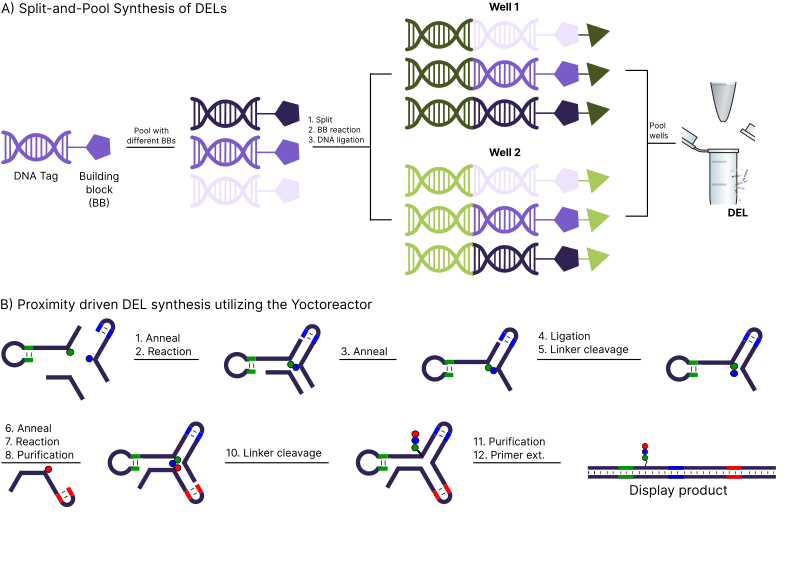
  • Unique platform strengths: YoctoReactor (Figure 2)/BTE/cBTE as technology differentiators
  • IP/series handling: your “hit reservation and series nomination” concept is a strong trust-builder—bring it up here too
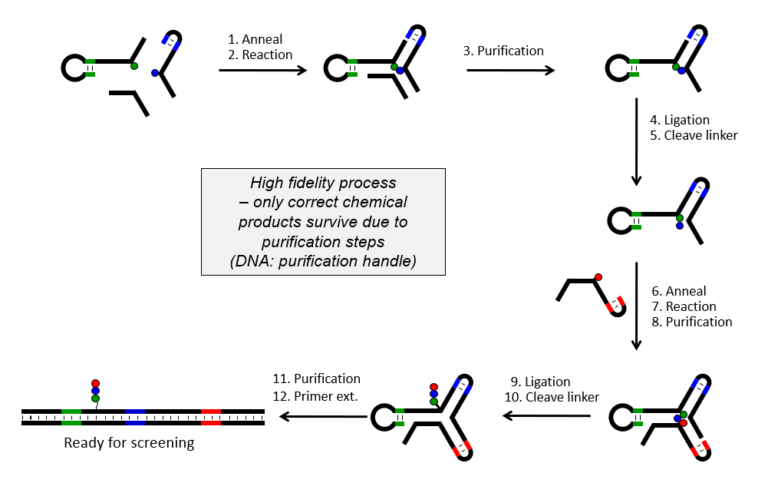
Diagram showing a high-fidelity DNA-encoded chemical synthesis process. Step 1: Two DNA-linked molecules anneal and react. Step 2: The product is purified. Step 3: Ligation of a new fragment, followed by cleavage of a linker. Step 4: A third fragment anneals and reacts. Step 5: Another purification step ensures only correct products continue. Step 6: Ligation and cleavage of the final linker. Step 7: Primer extension and final purification. The resulting DNA strand carries a chemical barcode (colored dots) and is ready for screening. A central note highlights the high fidelity of the process: “Only correct chemical products survive due to purification steps (DNA: purification handle).”

Figure 2: Vipergen’s method for DEL synthesis utilizing the YoctoReactor. The YoctoReactor ensures high fidelity libraries without truncates as only correct chemical products survive due to purification step.

Why utilizing DEL screening as part of medicinal chemistry campaign?

    1. It Expands Chemical Space Exploration: Where commercial screening decks cover up to one million compounds, a well-designed DEL explores hundreds of millions of small molecules. This jump of almost three-fold in magnitude uncovers novel scaffolds and binding modes which traditional small-molecule screening libraries rarely touch. Vipergen’s DELs introduces thousands of designer building blocks allowing for full exploration of chemical space. Our team works daily to expand the chemical space our DNA encoded libraries explores. 
    2. It Demands Precise Synthesis: Building a high-quality multi-million-member DEL is impossible without high-fidelity chemistry. At Vipergen we utilize our proprietary YoctoReactor technology (Figure 2) to construct DELs with a complete match between DNA barcode and the displayed small molecule. 
    3. It Requires Bioinformatics as Much as Bench Work: DEL selection data arrives as sequencing files, not IC50-values. Turning barcode counts into a ranked list of real molecules calls for dedicated informatics pipelines, sophisticated enrichment algorithms, and chemist who can understand both the statistics and the synthetic feasibility behind each hit. Coupling wet-lab and dry-lab expertise in one team minimizes hands-offs and maximizes interpretability. 
    4. It gives access to maximum diversity: Vipergen’s DELs are optimized to maximize 3D diversity by introducing building blocks which display different spatial orientations. This is done by introducing chemical building blocks with distinct cores to deliver 3D diversity. To further enhance 3D diversity these cores are diversified by their stereo- and positional-isomers.
    5. It Gives Access to Early Structure Activity Relationship: Vipergen’s DELs includes core scaffolds decorated with diverse sets of substituents. This means that once a hit is identified, structure activity relationship (SAR) information is readily available from the DEL screen

    Technology Overview behind Vipergen’s DEL-enabled medicinal chemistry

    Vipergen’s platform combines high-fidelity DEL construction, flexible selection formats, and data-to-compound follow-up chemistry:

    • YoctoReactor® (yR) DEL synthesis: Enables construction of very large, drug-like DELs with high fidelity between barcode and small molecule. 
    • Binder Trap Enrichment® (BTE): Homogeneous, solution-phase selection workflows designed to avoid immobilization and matrix effects common in solid-phase approaches. 
    • Cellular Binder Trap Enrichment® (cBTE): Enables DEL screening inside living cells, supporting target classes where purified protein is challenging and improving physiological relevance (Figure 3). 
    • NGS + informatics analysis: Turns sequencing output into ranked hit lists, clusters, and chemically actionable series shortlists.
    • Off-DNA resynthesis + QC: Converts prioritized sequences into purified, QC-verified compounds ready for confirmation assays and next-step decision making.
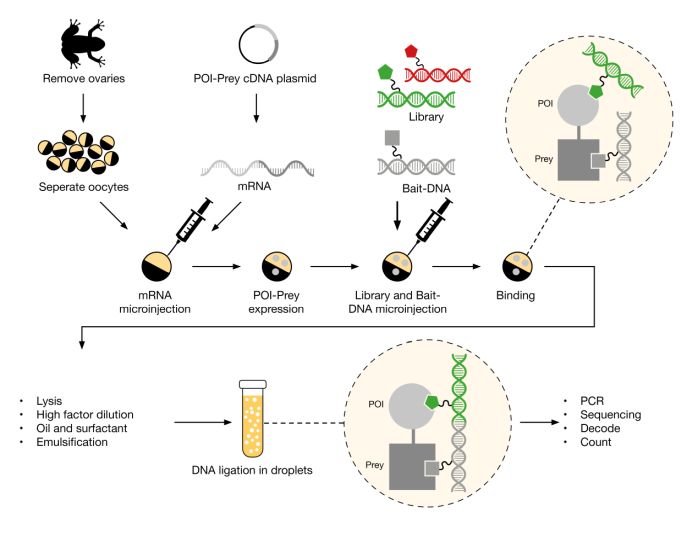
    Figure 3: Overview of Vipergen’s cellular Binder Trap Enrichment technology.

    Targets & applications supported by Vipergen DEL screening

    Vipergen’s DEL screening formats are designed to support challenging discovery scenarios, including:

    • Membrane and hard-to-purify targets using in-cell screening approaches where purified protein is not required. 
    • Protein–protein interaction (PPI) inhibitor discovery and related challenging interfaces. 
    • Molecular glue discovery using multiplexed screening strategies where applicable. 
    • Selectivity-focused screening including counter-screens against anti-targets to prioritize series with cleaner profiles early. 
    • In vitro DEL screening as an alternative when a purified target format is preferred. 

    Library Architecture

    • Scaffold-Centric Diversity: Each library member contains three-dimensional and sp3-rich core scaffolds chosen for synthetic tractability and physicochemical balance (Average for Vipergen’s Lib56: Fsp3 = 0.6; cLogP = 0.75; HBA/HBD within Lipinski limits; 343 different core-scaffolds). 
    • Orthogonal Encoding Tags: Our YoctoReactor technology ensures complete eliminations of truncates, ensuring every compound is uniquely addressable. 

    Selection Workflow

    • Screening in Living Cells: Our unique screening technique inside living cells allows for rapid screening against most target classes including membrane targets as purified protein is not needed. Read more about cellular Binder Trap Enrichment here. 
    • Screening in vitro: Besides screening in cells, we also perform more traditional DEL screenings in vitro. Here we utilize our Binder Trap Enrichment, which omits the need for target immobilization.
    • Positive and Negative Selection Rounds: We can directly screen both against target protein, but also counter-screen against non-targets which you want selectivity against. 
    • Screening Beyond Inhibitors: We have developed multiplex screening technologies, which allow for the direct identification of both molecular glues and protein-protein interaction inhibitors. Check out our full list of services here.

    Analysis Workflow

    • Next-Generation Sequencing (NGS) and Analysis: We analyze NGS data and compile a hit list and report. This includes metrics from the screen and chemical structure information. 
    • Hit reservation and Chemical Series Nomination: Hits are reserved for our clients for 1 year, where you may resynthesize and test in relevant assays. In this time, you may nominate chemical series, which becomes exclusive for you.

    Hit Resynthesis: Converting Sequences into Samples

    Waiting several months to obtain off-DNA hits negates the speed advantage of DEL Screening. We have synthetic capabilities to speed up that timeline as we have almost all building blocks in-house and a dedicated team ready to synthesize hit compounds at mg-scale which can fit into your medicinal chemistry campaign. As our DELs are constructed stepwise, resynthesis generally follows the same synthetic transformations making route planning directly available. All hit compounds are purified and undergo quality control. For most projects, the first milligrams of finalized off-DNA hits ship within a month.

    Need validated hits fast? Ask about typical resynthesis set sizes and a timeline aligned to your next program gate.

    Common challenge: DEL screening is fast, but if off-DNA compounds arrive months later, the speed advantage disappears and programs stall at the validation step.

    Vipergen’s solution: We convert prioritized DEL hits into purified, QC-verified off-DNA compounds on a competitive timeline—so your team can confirm activity and prioritize series without delay.

    Benefits of outsourcing DEL-enabled hit identification and resynthesis

    Partnering with a DEL specialist can reduce time-to-decision and de-risk early discovery by combining platform access with focused medicinal chemistry execution:

    • Acceleration: Move from selection data to validated compounds quickly, preserving the speed advantage of DEL screening. 
    • Reduced false starts: High-fidelity library design and chemically informed triage help prioritize series that are resynthesizable and testable. 
    • Integrated delivery: One team covers DEL execution, sequencing analysis, and follow-up resynthesis—minimizing handoffs and interpretation gaps. 
    • Flexibility: Engage in fee-for-service screening, selectivity add-ons, or multiplex strategies depending on your target biology and decision points. 

    Quality, Traceability, and Confidentiality

    Vipergen’s DEL-enabled medicinal chemistry services are built around traceability and fit-for-purpose quality control—from library design through hit nomination and off-DNA resynthesis. 

    How we support quality and data integrity

    • Traceable data flow from selection output (sequencing files) through analysis and reporting
    • Purification and QC of off-DNA hits prior to shipment to support reliable confirmation testing 
    • Chemically informed triage that accounts for synthetic feasibility and series logic, not enrichment alone 

    We routinely work under standard confidentiality terms (e.g., CDA/NDA) and align deliverables and reporting formats to your internal documentation needs.

    Engagement Models that Respect Your Pipeline

    Our DEL screening services can be scaled based on your needs. We can e.g. dimension our medicinal chemistry services to:

    • Easy and fast DEL screening in cells, where we initially perform an expression study, which is followed by one round of screening.
    • Direct selectivity screens, where we expand the screening against anti-target protein(s).
    • Multiplex screening to identify molecular glues and protein-protein interaction inhibitors.

    Common challenge: Discovery teams have different constraints—target format, selectivity requirements, timelines, and internal capacity—so a one-size-fits-all engagement slows decisions.

    Vipergen’s solution: Our medicinal chemistry services are modular: you can start lean and expand scope only when the data justify it.

    Check out the full series of services here and contact us about your project. 

    Do you have an inquiry?

    Contact us today and explore partnership opportunities.

    Get In Touch

    Related Services

    Service
    Small molecule drug discovery for even hard-to-drug targets – identify inhibitors, binders and modulators
    Molecular Glue Direct
    PPI Inhibitor Direct
    Integral membrane proteins
    Specificity Direct – multiplexed screening of target and anti-targets
    Express – optimized for fast turn – around-time
    Snap – easy, fast, and affordable

    Continue reading

    The Advantages of Using DNA-Encoded Libraries (DELs) in Hit Identification Compared to Traditional High-Throughput Screening (HTS)

    The Advantages of Using DNA-Encoded Libraries (DELs) in Hit Identification Compared to Traditional High-Throughput Screening (HTS)

    Get In Touch

    Abstract

    Hit identification remains a bottleneck in early drug discovery. Traditional high-throughput screening (HTS), while established and effective, is constrained by cost, throughput, and chemical space limitations. DNA-encoded libraries (DELs) have emerged as a transformative platform, enabling the screening of billions of compounds simultaneously through DNA barcoding and affinity selection. This article compares DEL Screening to HTS, detailing their advantages in terms of library diversity, efficiency, cost-effectiveness, and their suitability for difficult targets. It also discusses the technological advancements of platforms like Vipergen’s DEL YoctoReactor technology and the development of in-cell screening. These innovations underscore DELs’ growing role in next-generation drug discovery workflows.

    1. Introduction

    High-throughput screening (HTS) has long served as a cornerstone in early-stage drug discovery, enabling the systematic testing of chemical libraries against biological targets. While powerful, HTS is limited by the number of compounds that can be screened, infrastructure costs, and assay development complexity. DNA-encoded libraries (DELs), first proposed by Brenner and Lerner in 1992 [1], provide a radically different approach, using DNA barcodes to track compound identity and enabling the screening of up to 10¹² compounds in a single tube.

    DELs have since evolved into a widely adopted technology for identifying ligands against a broad range of targets, including those deemed “undruggable” [2–5]. Recent innovations, such as in-cell screening [2] and industry-specific platforms like Vipergen’s YoctoReactor® [6,11], have further expanded their utility, bridging the gap between biochemical binding and cellular relevance.

    2. Overview of HTS and DEL Technologies

    2.1 Traditional High-Throughput Screening

    HTS involves testing libraries of compounds—typically ranging from 10⁴ to 10⁶ unique molecules—against a biological assay in miniaturized formats using automated robotic systems. Hits are identified based on activity readouts such as fluorescence, luminescence, or phenotypic changes [7]. While effective, HTS requires substantial investment in infrastructure, compound management, and assay development, especially when multiple screening campaigns are required.

    2.2 DNA-Encoded Libraries

    In DELs, small molecules are synthesized with covalently attached DNA tags that encode their synthetic history [1-5]. Libraries are generated using split-and-pool combinatorial methods and screened in pooled format by affinity selection against purified proteins. After selection, retained DNA tags are amplified and sequenced, with bioinformatic analysis revealing enriched sequences indicative of binding [2,3].

    3. Comparative Advantages of DELs Over HTS

    3.1 Chemical Space and Library Size

    DELs enable access to chemical libraries several orders of magnitude larger than HTS. While HTS screens up to 10⁶ compounds, DELs can incorporate up to 10¹² molecules [4,5]. The combinatorial nature of DEL synthesis, combined with access to natural-product-inspired scaffolds and macrocycles, allows for much broader chemical space exploration [4,5].

    3.2 Screening Throughput and Efficiency

    DELs achieve ultra-high throughput by screening all library members in a single tube using target affinity as the selection mechanism. This reduces assay time to days and requires only nanogram-scale protein quantities [2,3]. In contrast, HTS is constrained by physical compound handling, reagent use, and labor-intensive data collection [8].

    3.3 Cost Considerations

    Once a DEL is synthesized, it can be reused for many targets with minimal incremental cost. The primary expenses relate to sequencing and initial library generation, both of which continue to decrease [4,5]. HTS, by comparison, involves ongoing costs for compound management, assay reagents, and maintenance of high-throughput infrastructure [8].

    3.4 Binding-Based vs. Functional Readouts

    DELs identify binders rather than functional modulators. This distinction can be advantageous when the goal is to target protein–protein interactions or identify scaffolds for further optimization [9]. HTS, on the other hand, selects compounds based on biological activity, which may be influenced by assay artifacts or off-target effects [8].

    4. Advances in DEL Technologies

    4.1 Vipergen’s DEL YoctoReactor® Platform

    Vipergen has developed a proprietary DEL platform utilizing their YoctoReactor® technology, which improves the fidelity of DEL synthesis by conducting reactions in discrete, miniaturized environments [2,6]. This reduces side reactions and improves product integrity.

    4.2 In-Cell DEL Screening

    A major breakthrough was reported by Petersen et al. in 2021, demonstrating DEL screening inside living cells [2]. Vipergen’s cBTE DEL platform allows affinity selection in intact cells, significantly increasing physiological relevance and mitigating false positives caused by in vitro artifacts. This innovation bridges a critical gap between DEL binding assays and the functional cellular context that traditional DELs could not address.

    5. Limitations of DELs

    Despite their advantages, DELs have limitations:

    • DNA-Compatible Chemistry: Reactions used in DEL synthesis must be mild and aqueous-compatible, which limits synthetic diversity [2-5].
    • Target Format Constraints: DELs are most effective with soluble, purified proteins, which excludes many membrane-bound or multi-protein complexes unless novel approaches like those from Vipergen are used [4,5].
    • False Positives: Nonspecific binders, including DNA-binding molecules, may be enriched. Counter-selection and orthogonal validation are essential [9].

    Lack of Functional Insight: Hits identified through binding may not translate to functional activity, requiring follow-up biochemical or cell-based assays [9].

    6. Integration with Other Platforms

    DELs can be synergistically combined with HTS, fragment-based drug discovery (FBDD), and artificial intelligence. DEL-derived hits are often validated with HTS assays to confirm activity [4,5,9]. Furthermore, DELs incorporating fragment-like scaffolds can benefit from structure-guided optimization. Emerging machine learning tools are being developed to analyze DEL enrichment data and predict SAR trends [7].

    7. Conclusion and Outlook

    DNA-encoded libraries offer unprecedented advantages in chemical diversity, screening throughput, and cost-efficiency. With innovations like intracellular DEL screening [2] and advanced platforms from Vipergen [6], DELs are closing the gap between in vitro binding and in vivo relevance. While HTS remains indispensable for functional assays, DELs are now a central pillar in early hit discovery—especially for difficult targets and novel mechanisms of action.

    As new DNA-compatible chemistries, in vivo screening techniques, and integrated data analysis tools emerge, DELs are poised to lead a new era of rapid, efficient, and target-tailored drug discovery [10].

    References

    1. Brenner, S., & Lerner, R. A. (1992). Encoded combinatorial chemistry. Proceedings of the National Academy of Sciences, 89(12), 5381–5383. https://doi.org/10.1073/pnas.89.12.5381
    2. Petersen, L. K., Christensen, A. B., Andersen, J., Folkesson, C. G., Kristensen, O., Andersen, C., Alzu, A., Sløk, F. A., Blakskjær, P., Madsen, D., Azevedo, C., Micco, I., & Hansen, N. J. V. (2021). Screening of DNA-encoded small molecule libraries inside a living cell. Journal of the American Chemical Society, 143(7), 2751–2756. https://doi.org/10.1021/jacs.0c09213
    3. Clark, M. A., Acharya, R. A., Arico-Muendel, C. C., Belyanskaya, S. L., Benjamin, D. R., Carlson, N. R., Centrella, P. A., Chiu, C. H., Creaser, S. P., Cuozzo, J. W., Davie, C. P., Ding, Y., Franklin, G. J., Franzen, K. D., Gefter, M. L., Hale, S. P., Hansen, N. J. V., Israel, D. I., Jiang, J., … Morgan, B. A. (2009). Design, synthesis and selection of DNA-encoded small-molecule libraries. Nature Chemical Biology, 5, 647–654. https://doi.org/10.1038/nchembio.211
    4. Favalli, N., Bassi, G., Scheuermann, J., & Neri, D. (2018). DNA-encoded chemical libraries—Achievements and remaining challenges. FEBS Letters, 592(12), 2168–2180. https://doi.org/10.1002/1873-3468.13068
    5. Gironda-Martínez, A., Donckele, E. J., Samain, F., & Neri, D. (2021). DNA-encoded chemical libraries: A comprehensive review with successful stories and future challenges. ACS Pharmacology & Translational Science, 4(4), 1265–1279. https://doi.org/10.1021/acsptsci.1c00118
    6. Vipergen A/S. (2023). Technology overview. https://www.vipergen.com
    7. Iqbal, S., Jiang, W., Hansen, E., Ghosh, A., Hou, Y., Wang, X., & Li, J. (2025). Evaluation of DNA encoded library and machine learning model combinations for hit discovery. NPJ Drug Discovery, 2, 5. http://dx.doi.org/10.1038/s44386-025-00007-4
    8. Macarron, R., Banks, M. N., Bojanic, D., Burns, D. J., Cirovic, D. A., Garyantes, T., Green, D. V. S., Hertzberg, R. P., Janzen, W. P., Paslay, J. W., Schopfer, U., & Sittampalam, G. S. (2011). Impact of high-throughput screening in biomedical research. Nature Reviews Drug Discovery, 10, 188–195. https://doi.org/10.1038/nrd3368
    9. Goodnow, R. (2018). DNA-encoded library technology (DELT) after a quarter century. SLAS Discovery, 23(5), 385–386. https://doi.org/10.1177/2472555218766250
    10. Goodnow, R. A., Dumelin, C. E., & Keefe, A. D. (2017). DNA-encoded chemistry: Enabling the deeper sampling of chemical space. Nature Reviews Drug Discovery, 16, 131–147. https://doi.org/10.1038/nrd.2016.213
    11. Hansen, M. H., Blakskjær, P., Petersen, L. K., Hansen, T. H., Højfeldt, J. W., Gothelf, K. V., & Hansen, N. J. V. (2009). A yoctoliter-scale DNA reactor for small-molecule evolution. Journal of the American Chemical Society, 131(3), 1322–1327. https://doi.org/10.1021/ja808558a

    Do you have an inquiry?

    Contact us today and explore partnership opportunities.

    Get In Touch

    Related Services

    Service
    Small molecule drug discovery for even hard-to-drug targets – identify inhibitors, binders and modulators
    Molecular Glue Direct
    PPI Inhibitor Direct
    Integral membrane proteins
    Specificity Direct – multiplexed screening of target and anti-targets
    Express – optimized for fast turn – around-time
    Snap – easy, fast, and affordable

    Continue reading

    DNA-Encoded Libraries vs. Fragment-Based Screening: Pros and Cons

    DNA-Encoded Libraries vs. Fragment-Based Screening: Pros and Cons

    Choosing the right hit-finding strategy for your next drug-discovery program

    Get In Touch

    Executive Summary

    DNA-encoded library (DEL) screening and fragment-based drug discovery (FBDD) have emerged as two leading alternatives to conventional high-throughput screening for small-molecule hit identification. Both strategies deliver novel chemotypes, yet they diverge in scale, logistics and the biological insight they deliver.
    This article unpacks how each technology works, weighs their respective strengths and limitations, and illustrates how Vipergen’s cellular Binder Trap Enrichment (cBTE) extends the reach of DEL screening from purified protein to live-cell target engagement.
    Readers working in pharmaceutical R&D will gain a clear decision framework for selecting the most time- and cost-effective hit-finding path for a given target.

    1. Technology Primers

    1.1 Fragment-Based Screening (FBS/FBDD)

    Fragment‐based approaches purposely start small. Libraries of 1 000–2 000 low-molecular-weight compounds (typically 150–300 Da, following the Rule of Three) are screened individually by highly sensitive biophysical methods—most commonly nuclear magnetic resonance (NMR), surface plasmon resonance (SPR), thermal shift assays, or X-ray crystallography (Erlanson 2016). Fragments bind weakly (µM–mM), but because they are so small they often sample binding hot-spots that large molecules miss. Once weak binders are confirmed, medicinal chemists apply grow, merge, or link strategies, using structural guidance to build potency and selectivity.

    Importantly, each fragment needs to be pre-selected for synthetic tractability: the molecules contain versatile functional handles and follow well-established chemistry rules, so medicinal chemists can rapidly elaborate any hit into dozens of analogues for systematic structure–activity relationship (SAR) exploration without having to develop new synthetic routes.

    1.2 DNA-Encoded Library (DEL) Screening

    DNA-encoded libraries take the opposite stance: instead of depth, they go broad. Each small molecule is covalently tagged with a unique DNA barcode that records its synthetic lineage, enabling billions of distinct compounds to be pooled in a single test tube while preserving identity (Goodnow 2017).
    In a typical selection the library is incubated with the target, non-binders are washed away, the retained DNA tags are PCR-amplified, and next-generation sequencing (NGS) reveals which chemotypes were enriched. Because each compound carries its own barcode, millions can be screened in parallel. In practice we have found that libraries in the hundred-million range (Vipergen routinely deploys 400–600 million members) already capture the vast majority of accessible chemical motifs, delivering low-nanomolar binders without the diminishing returns that accompany ever-larger pools.
    With Vipergen’s YoctoReactor® chemistry we routinely build libraries in the 10^8 scale; our Binder Trap Enrichment (BTE) workflow keeps selections in solution, and cellular Binder Trap Enrichment (cBTE) moves the whole screen into living mammalian cells, bypassing the purified-protein requirement through direct intracellular delivery.

    2. Comparative Pros & Cons

    Project teams must weigh multiple factors—throughput, protein burden, chemical starting point, data overhead and cost—when choosing a hit-finding strategy. The table below provides a concise, side-by-side comparison.

    Aspect DNA-Encoded Libraries Fragment-Based Screening
    Throughput & speed Screens ~10^8 compounds as quickly as in one month (Indsæt link til SNAP-Easy-Fast-and-Affordable); sequencing replaces manual hit picking. ≤ 2 k measurements; several months of instrument time.
    Protein requirement 10–50 µg purified protein; zero with Vipergen cBTE (live-cell selection). mg quantities of highly pure, often crystallisable protein.
    Hit affinity window nM–low-µM primary hits thanks to massive diversity. mM–high-µM; potency built later by medicinal chemistry.
    Chemical diversity Millions of drug-like, 3D-rich scaffolds, sp³-rich motifs. Smaller, “privileged” library; chemistry is immediately tractable.
    Physicochemical start point Average MW 300–600 Da (DNA linker included); re-synthesis off-DNA obligatory. MW ≤ 300 Da; ample property space to grow into a drug.
    Target class coverage Soluble proteins, PPIs, RNA and—with cBTE—membrane or multiprotein complexes in situ. Best for targets compatible with immobilization or crystallography; challenging for IDPs & membranes.
    Data load & analytics Millions of reads demand bioinformatics but enable robust statistics. Dozens of spectra; interpretation is direct but manual.
    Cost of entry Library access + NGS are modest; CRO option eliminates capital expenditure. High capital expenditure for NMR, SPR, X-ray and protein production pipeline.
    IP positioning Novel scaffolds → broad composition-of-matter claims. Often reiterates known cores; IP strength comes from structure-guided vectors.

    Key takeaway: DEL delivers unrivalled chemical breadth with minimal protein burden, whereas FBS provides immediate structural insight when those resources are available.

    3. Vipergen’s cBTE: Turning DEL Inside-Out

    Traditional DEL selections stop at purified protein. Vipergen’s proprietary cellular Binder Trap Enrichment (cBTE) enables selection inside living Xenopus laevis oocytes—large amphibian cells that can be readily microinjected:

    • No purification bottleneck – screening can begin after expression has been validated in cells.
    • Physiological context – the target protein is expressed and screened in a crowded cytosol with native post-translational modifications and cofactors.
    • Direct intracellular delivery – microinjection bypasses membrane permeability altogether; hit recovery is driven purely by target affinity, not by passive cell entry.

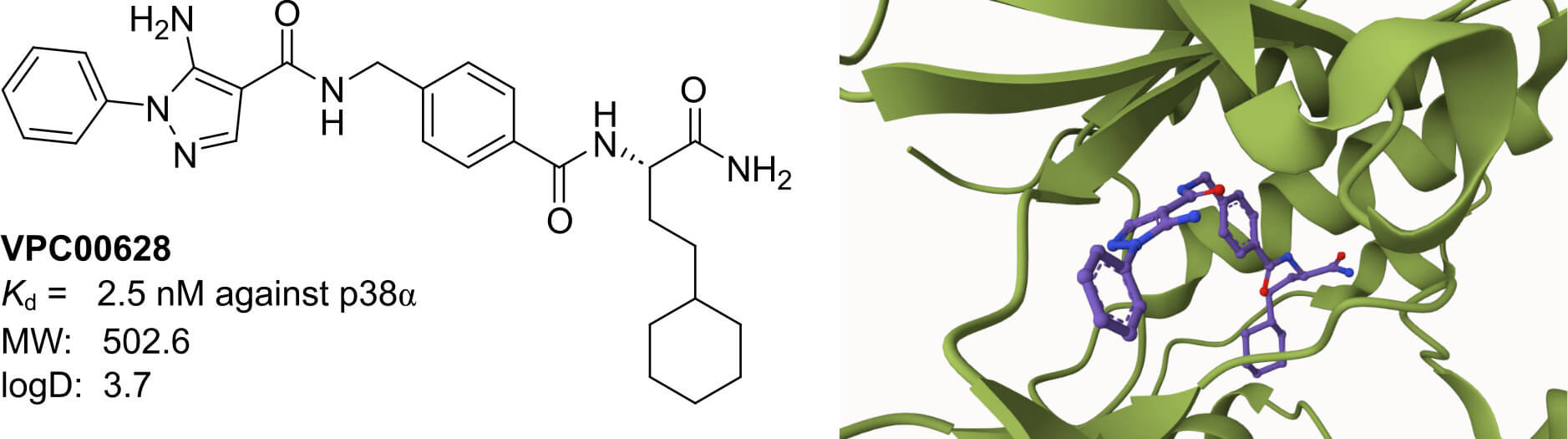
    A 194-million-member proof-of-concept screen identified multiple low-nanomolar chemotypes against three therapeutically relevant targets (p38α, ACSS2, DOCK5) inside live oocytes (Petersen 2021).

    4. Where Fragment-Based Screening Still Shines

    FBDD remains unmatched when atomic-resolution data or ultra-shallow pockets are essential:

    1. Structure-guided design from Month1 – co-crystal or cryo-EM structures of fragments provide an atom-by-atom roadmap for medicinal chemistry.
    2. Tackling cryptic or allosteric sites – small fragments can insinuate into transient pockets that larger molecules may miss.
    3. Rapid SAR loops – once a fragment is validated, chemists can iterate monthly with clear biophysical feedback.

    Albeit this, the workflow is still labor-intensive – each fragment must be screened and validated one-by-one across multiple biophysical platforms, and every confirmed hit then demands significant medicinal-chemistry effort for grow/merge/link optimization, often requiring many synthesis cycles before potency reaches the desired threshold.

    5. Decision Framework

    The table below summarizes when each technology is likely to deliver the greatest return on investment.

    Decision Question DEL (with cBTE) FBDD
    Is purified protein hard or time-consuming to obtain? Yes – proceed with cBTE No advantage
    Is atomic-resolution structural data required at the hit stage? Not essential Yes – choose FBDD
    Target-to-hit timeline ≤ 6 months? Faster Slower
    Do you already have biophysics infrastructure and expertise in-house? Not critical Yes – FBDD capitalises on it

    In short, if protein supply and biophysical infrastructure are readily available, then FBDD might be the optimal starting point for a drug discovery campaign. On the other hand, if the protein of interest is difficult to access in larger quantities (e.g. membrane proteins) and is difficult to crystallize, then DEL screening might be the method of choice. 

    Bottom line: For targets where protein supply or cellular relevance is a challenge, Vipergen’s cBTE-enabled DEL workflow offers the most direct path to potent, cell-active leads within a pragmatic month-scale timeline.

    6. Regulatory & IP Considerations

    Regulatory agencies evaluate small-molecule drugs on the same fundamental criteria—safety, efficacy, and manufacturing quality—regardless of how the initial hit was discovered. However, there are practical distinctions:

    DEL hits and composition-of-matter (COM) claims – The massive chemical diversity inherent to DEL allows discovery of previously unreported scaffolds. Sponsors often secure broad COM patents that cover the core chemotype plus close analogues, providing a wide moat around early leads.

    FBDD and structure-guided claims – Fragment-derived series frequently build on well-known heteroaromatic cores. IP strength therefore comes from claiming specific vectors and 3-D binding modes revealed by crystallography. Claims can be narrower unless novel chemistry is introduced during fragment growth.

    Regulatory familiarity – Both technologies have produced clinical candidates, but agency reviewers now see DEL-origin molecules more frequently, and the first DEL-discovered drugs have entered Phase II. Meanwhile, nine FDA-approved small-molecule drugs trace roots to FBDD, demonstrating clear regulatory precedent.

    Freedom-to-operate (FTO) – Because DEL libraries contain unique scaffolds synthesized in-house, FTO risk is often lower than for fragment hits that may overlap with prior art. Early IP landscaping should still be carried out in either case.

    Taken together, DEL can deliver a stronger IP position out-of-the-gate, while FBDD’s structural clarity speeds claim drafting for specific binding interactions.

    References

    • Erlanson D. A. et al., Twenty years on: the impact of fragments on drug discovery Nat. Rev. Drug Discov. 2016, 15, 605–619. doi.org/10.1038/nrd.2016.109
    • Goodnow R. A. et. al., DNA-encoded chemistry: enabling the deeper sampling of chemical space, Nat. Rev. Drug Discov. 2017, 16, 131–147. doi.org/10.1038/nrd.2016.213
    • Petersen L. K. et al., Screening of DNA-Encoded Small-Molecule Libraries inside a Living Cell, J. Am. Chem. Soc. 2021, 143, 2751-2756. doi.org/10.1021/jacs.0c09213

    Do you have an inquiry?

    Contact us today and explore partnership opportunities.

    Get In Touch

    Related Services

    Service
    Small molecule drug discovery for even hard-to-drug targets – identify inhibitors, binders and modulators
    Molecular Glue Direct
    PPI Inhibitor Direct
    Integral membrane proteins
    Specificity Direct – multiplexed screening of target and anti-targets
    Express – optimized for fast turn – around-time
    Snap – easy, fast, and affordable

    Continue reading

    DNA Encoded Libraries: Principle of DNA-Compatible Chemical Reactions for High-Throughput Small Molecule Discovery

    DNA Encoded Libraries: Principle of DNA-Compatible Chemical Reactions for High-Throughput Small Molecule Discovery

    Get In Touch

    DNA-encoded libraries (DELs) are powerful tools for drug discovery, uniquely combining features of genetically encoded libraries—via DNA barcoding—with the structural diversity of synthetic combinatorial libraries. In DEL synthesis, small molecules are covalently linked to unique DNA tags, enabling the pooling and parallel screening of vast compound libraries. Although it is theoretically possible to synthesize each small-molecule library member individually and attach a DNA tag, this process would undermine the efficiency advantages DELs offer over traditional high-throughput screening (HTS) methods. To preserve throughput, DEL synthesis relies on DNA-compatible chemical reactions performed in a split-and-pool format with the DNA barcode present throughout synthesis.

    Key criteria for successful DNA-compatible chemistry in DEL construction include:

    • Use of reagents and solvents that are physically compatible with DNA (e.g., mild conditions, water or polar solvents, non-acidic pH, limited temperature range).
    • Maintenance of DNA integrity, particularly the preservation of sensitive functional groups such as deoxyribose sugars, phosphodiester backbones, and aniline-containing nucleobases.
    • High-yielding reactions or robust purification strategies to eliminate side products in pooled mixtures.
    • Broad substrate scope to maximize chemical diversity and expand DEL coverage.

    These principles guide the design of effective and scalable DELs for identifying biologically active small molecules in early-stage drug development.

    Common Synthetic Transformations for DEL Formation

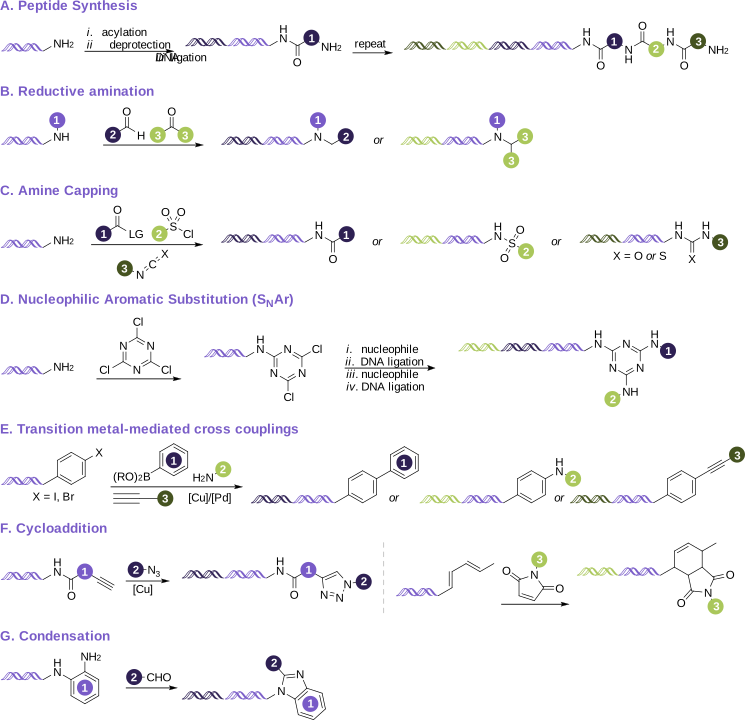
    Although multiple novel chemical transformations are reported every year, a few reactions are utilized in most synthesized DELs (Scheme 1) [Song and Hwang 2020, Shi 2021]:

    • Amide formation
    • Reductive amination
    • Amine capping with electrophiles
    • Nucleophilic aromatic substitution
    • Transition metal-mediated cross coupling
    • Cycloaddition
    • Condensation reaction

    This is both because these reactions are DNA-compatible across a broad range of similar building blocks and the availability of structurally diverse building blocks. 

    Scheme 1: Common synthetic steps utilized for the construction of DELs.

    Transition metal-mediated cross coupling reactions are not only limited to the Suzuki, Sonogashira and Ullmann coupling shown in Scheme 1E, but also includes Heck coupling and other C-N coupling reactions. Similarly, a wide variety of condensation reactions have been reported for the formation of a broad range of heterocyclic moieties including:

    • Benzimidazoles
    • Imidazolidinones
    • Quinazolinones
    • Imidazopyridines
    • Tetrahydroquinolines
    • Polycyclic isoxazolidines
    • Spiroheterocycles
    • Thiazole fused dihydropyrans
    • Isoquinolones
    • Imidazoles
    • Oxadiazoles
    • Tetrazoles

    Deprotection Reactions During DEL Synthesis

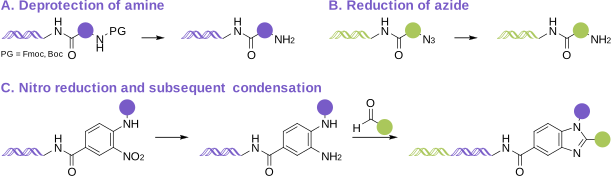
    Albeit not introducing chemical diversity directly deprotection reactions are vital for DEL synthesis. Most often amines need to be liberated for subsequent diversification especially if bi- and tri-functional DEL building blocks are utilized. Besides, commonly employed deprotection strategies (removal of Boc and Fmoc, Scheme 2A) novel approaches have been developed. These include the reduction of azides to the corresponding amine (Scheme 2B) and (hetero)aromatic nitro groups to the corresponding anilines. The nitro reduction strategy is an elegant way to construct DELs by first utilizing the nitro to direct a SNAr reaction and secondly reduce it to an aniline which can be the next point of reaction (Scheme 2C). Besides the reactions shown in Scheme 2, examples of alloc deprotection has also been shown. Finally carboxylic acids can be accessed from the corresponding methyl, ethyl or tert-Butyl ester by hydrolysis. 

    Scheme 2: Common deprotection strategies to liberate free amines and anilines. 

    Multicomponent Reactions

    Besides creating libraries by the stepwise addition of building blocks, in the past years multicomponent reactions have sparked interest as they allow for rapid diversification (Shi 2021). The reactions used for DEL synthesis include:

    • Petasis reaction
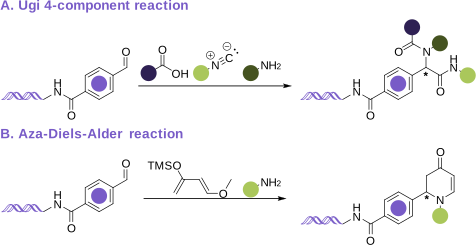
    • Ugi 4-component reaction (Scheme 3A) and variations of this
    • Passerini reaction
    • Povarov reaction
    • Aza-Diels-Alder reaction (Scheme 3B)

    Scheme 3: Examples of multicomponent reactions used for the synthesis of DNA-encoded libraries. * indicates that both enantiomers are formed. 

    The major issue with these reactions is the need for a diverse set of specialized building blocks such as isocyanides, aldehydes and olefins. As the commercially available building blocks of these types are limited the libraries which can be generated will be limited. Furthermore, at least one of the building blocks (typically an aldehyde) needs to be bifunctional to be attached to the DNA, which further limits the amount of available building blocks. Finally, e.g. the Ugi reaction has not been shown to be enantioselective.

    Ring Closing Reactions

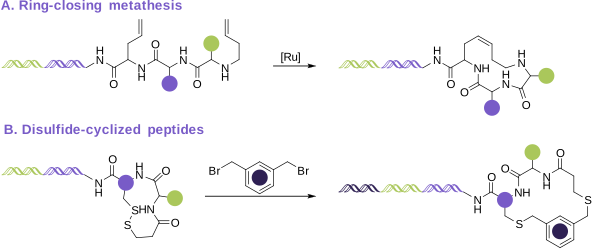
    The formation of macrocyclic libraries using DELs is not new. Macrocyclic structures are especially interesting as they have found use as protein-protein interaction (PPI) inhibitors (Martí-Centelles 2015). Today several methods exist, including simple reactions forming e.g. amide bonds. More recently ring-closing metathesis (RCM), and the reaction of disulfides with bis-electrophiles have emerged as powerful methods. Utilizing bis-electrophiles also allows for diversification as the range of these is expanding.

    Scheme 4: Examples of synthesis of DNA encoded macrocyclic chemical libraries.  

    Photoredox-Based Reactions

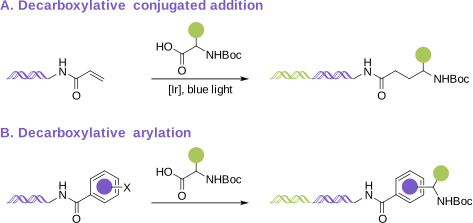
    Photoredox based methods have emerged over the past few years in organic chemistry to generate radicals. These radicals have successfully been applied to react with radical acceptors (E.g. Michael acceptors and styrene’s) on-DNA for the successful DEL synthesis. Most radical precursors used for DEL synthesis are derived from α-amino acids, which can undergo decarboxylative conjugated additions as exemplified by the Giese reaction. Besides conjugative additions, Ni/Photoredox reactions have also been developed for various sp3-sp2 and sp3-sp3 cross-coupling reactions, defluorinative alkylations, and decarboxylative arylations. Utilizing N-Boc amino acids for the photoredox based decarboxylative reactions give easy access to an amine, which can be utilized for the subsequent rounds for DEL construction.  

    Scheme 5: Examples of Photoredox-based reaction for the construction of DNA Encoded Libraries.

    Beyond aqueous conditions for on-DNA chemistry

    Though not a new concept as it was initially described by Halpin and Harbury in 2004, DNA and hereby DELs can be reversibly absorbed to solid support, which allows for water-free reactions in organic solvents (Halpin and Harbury 2004). The solid support utilized is positively charged diethylammoniumethanol-sepharose or as reported by Baran and Dawson based

     on quaternary ammonium. Allowing for near-anhydrous conditions opens op to broad range of reactions, and examples exist of Ni-mediated cross-couplings and electrochemical aminations (Flood 2019). 

    To overcome the challenges associated with DNA degradation when treated to acidic conditions a micellar system has been developed (Škopić 2019) Herein sulfonic acids were introduced in the lipophilic part of an amphiphilic copolymer. This allowed for the Brønsted acid to only be present within the micelle, where the small molecule can enter, but not the DNA-tag allowing for the diversification of aldehydes to tetrahydroquinolines and aminoimidazopyridines by Povarov and Groebke–Blackburn–Bienaymé reactions. Further the system was utilized for oxidation of alcohols to aldehydes as well as Boc deprotection under acidic conditions.

    Conclusion

    DNA-encoded libraries (DELs) have revolutionized early-stage drug discovery by enabling the rapid, high-throughput screening of vast chemical spaces through the fusion of combinatorial chemistry and DNA barcoding. Central to this platform is the ability to perform DNA-compatible chemical reactions that maintain the integrity of the DNA tag while allowing broad synthetic versatility. As the field has evolved, a robust toolbox of established reactions—including amine modifications, cross-couplings, and multicomponent transformations—has laid the groundwork for reliable DEL synthesis. Meanwhile, the emergence of advanced methodologies such as photoredox catalysis, ring-closing reactions, and solid-support-based approaches continues to expand the chemical space accessible through DELs. These innovations not only increase the structural diversity of libraries but also improve the functional group tolerance and synthetic efficiency necessary for navigating the complexity of drug-like molecules. Looking forward, the ongoing development of new DNA-compatible reactions, improved building block availability, and optimized reaction conditions will further enhance the scope and utility of DELs, cementing their role as a cornerstone technology in modern drug discovery.

    References

    • Flood, D. T. et. al. (2019), Expanding Reactivity in DNA-Encoded Library Synthesis via Reversible Binding of DNA to an Inert Quaternary Ammonium Support, 141, 25, 9998-10006. doi.org/10.1021/jacs.9b03774
    • Flood, D. T. et. al. (2020), DNA Encoded Libraries: A Visitor’s Guide, Isr. J. Chem., 60, 268-280. doi.org/10.1002/ijch.201900133
    • Halpin, D. R. and Harbury, R. B. (2004), DNA Display I. Sequence-Encoded Routing of DNA Populations, PLoS Biology, 2 (7), 1015-1021. doi.org/10.1371/journal.pbio.0020173
    • Martí-Centelles, V. et. al. (2015), Macrocyclization Reactions: The Importance of Conformational, Configurational, and Template-Induced Preorganization, Chem. Rev., 115, 16, 8736-8834. doi.org/10.1021/acs.chemrev.5b00056
    • Shi, Y. et. al. (2021), DNA-encoded libraries (DELs): a review of on-DNA chemistries and their output, RSC Adv., 11, 2359-2376. doi.org/ 10.1039/d0ra09889b
    • Škopić, M. K. et. al. (2019), Micellar Brønsted Acid Mediated Synthesis of DNA-Tagged Heterocycles, J. Am. Chem. Soc., 141, 26, 10546-10555. doi.org/10.1021/jacs.9b05696
    • Song, M., Hwang, G. T. (2020), DNA-Encoded Library Screening as Core Platform Technology in Drug Discovery: Its Synthetic Method Development and Applications in DEL Synthesis, J. Med. Chem., 63, 6578-6599. doi.org/10.1021/acs.jmedchem.9b01782a

    Do you have an inquiry?

    Contact us today and explore partnership opportunities.

    Get In Touch

    Related Services

    Service
    Small molecule drug discovery for even hard-to-drug targets – identify inhibitors, binders and modulators
    Molecular Glue Direct
    PPI Inhibitor Direct
    Integral membrane proteins
    Specificity Direct – multiplexed screening of target and anti-targets
    Express – optimized for fast turn – around-time
    Snap – easy, fast, and affordable

    Continue reading

    Understanding DEL Screening: From Target Binding to Hit Validation

    DEL screening

    Understanding DEL Screening

    DNA-encoded library (DEL) screening revolutionizes early drug discovery through four decisive advantages. First, chemical scope: combinatorial synthesis paired with DNA barcoding empowers libraries of 108–1012 distinct small molecules, dwarfing traditional HTS collections. Second, efficiency: pooled selections require picomole amounts of compound and target, slashing reagent costs and cycle time. Third, data richness: next-generation sequencing yields highly quantitative enrichment profiles, enabling immediate structure–activity insights from a single binding experiment. Finally, versatility: DEL selections run against purified proteins, surface receptors, RNA, or in live cells, and can be rapidly iterated with off-DNA resynthesis and follow-up chemistry, accelerating translation from hit to lead.

    Get In Touch

    Understanding DEL Screening: From Target Binding to Hit Validation

    DNA-Encoded Library (DEL) technology has rapidly become a cornerstone in modern drug discovery. It enables researchers to screen millions of small molecules in a single tube, identify potent binders to a protein target, and validate those hits in record time—all while consuming minimal material and resources.

    In this article, we provide a comprehensive walkthrough of the DEL screening process—from initial target engagement to hit confirmation. We’ll cover both classical techniques and novel advancements, including methods demonstrated in cutting-edge studies such as yoctoReactor (yR)-based homogeneous screening and in vivo DEL screening using Xenopus laevis oocytes.

    What Is DEL Screening?

    DNA-Encoded Libraries are a fusion of chemistry and molecular biology. Each small molecule in the library is covalently linked to a unique DNA tag that encodes the molecule’s synthetic pathway. This barcoding allows for high-throughput identification of binding molecules via next-generation sequencing. Vipergen utilizes its yoctoReactor (yR) technology to synthesize DELs with 100 % correspondence between DNA-barcode and the displayed small molecule.

    Read about YoctoReactor

    DEL screening is fundamentally a “fishing expedition”. Instead of testing one molecule at a time, DEL allows millions of compounds to interact with a target simultaneously. After incubation, those compounds that bind to the protein of interest are enriched, recovered, and identified through DNA sequencing.

    The result? A faster, more efficient, and more scalable approach to early hit discovery than traditional high-throughput screening (HTS).

    Step-by-Step Overview of DEL Screening

    • Target Identification: Clarify the biological question, then select a purified protein, protein complex, or cell-surface presentation that is drug-relevant, structurally characterized, and obtainable at ≥95 % purity. Confirm catalytic activity or ligand binding by an orthogonal assay (e.g., SPR or enzymatic turnover). Map allosteric and orthosteric sites, note essential cofactors, and define screening conditions (pH, salt, detergent, divalent ions) that keep the target stable ≥24 h at 4 °C. Reserve at least 0.5–1 mg for selections. Alternatively, skip most of these steps and utilize Vipergen’s Cellular Binder Trap Enrichment here.
    • Library Synthesis: A wide range of chemical reactions have over the past two years been adapted to be compatible with DEL synthesis (Read about DNA compatible chemical reactions here). DELs are usually synthesized by split-and-pool combinatorial chemistry, but other methods such as Vipergen’s Yoctoreactor also exist.
    • Selection & Amplification: Incubate the encoded library with immobilized or soluble target under near-physiological buffer for 1–2 h. Separate binders via affinity capture or size-exclusion, then wash stringently to remove nonspecific DNA. Elute bound complexes (heat, imidazole, competitive ligand). PCR-amplify recovered DNA, re-associate with its small-molecule (if required), and repeat 2–4 selection rounds, gradually increasing wash stringency.
    • Hit Decoding: Deep-sequence the final PCR pool (Illumina or similar). Translate DNA barcodes to chemical structures with the synthesis map. Quantify enrichment by comparing read counts to the naïve library; typical meaningful enrichments are >10- to 1000-fold. Use clustering to identify chemotypes and remove PCR or sequencing artefacts. Output a ranked hit list with calculated phys-chem properties and any known PAINS alerts flagged.
    • Biological and Chemical Validation: Resynthesize top 20–200 compounds off-DNA at ≥95% purity. Confirm identity by LC-MS and NMR. Test binding/functional activity in orthogonal biophysical (SPR, ITC, DSF) and cellular assays, determining KD/IC50. Evaluate selectivity across close homologues and ADME liabilities (microsomal stability, CYP inhibition). Prioritize hits showing reproducible potency, clean spectra, and tractable chemistry for follow-up medicinal-chemistry optimization.

    Step 1: Target Binding – Classical In Vitro Methods

    Immobilization-Based DEL Screening

    This is the original method of DEL screening (Gironda-Martínez 2021). The protein of interest (POI) is chemically attached to a solid matrix (e.g. magnetic beads or polymer based resin). The library is incubated with immobilized protein, allowing binders to attach (Figure 1). Unbound or weakly bound compounds are washed away in a series of buffer washes. Once washing is complete, the retained DNA-linked molecules are eluted, PCR amplified, and sequenced.

    DEL screening workflow

    Figure 1: Affinity bases DEL Screening by incubation of DEL with a POI immobilized on beads. Following elution the DNA is PCR amplified and sequenced.

    Pros:

    • Easy to implement in most labs
    • Useful for well-characterized, stable proteins

    Challenges:

    • Immobilization can distort the protein’s native conformation
    • The washing steps may strip off weak but potentially valuable binders
    • Nonspecific binding to the matrix can generate false positives

    This method laid the groundwork for more refined techniques and remains useful in certain contexts. Although new methods exist, variations to this protocol (e.g. immobilizing the POI after incubation with DEL) is still the method of choice for many companies.

    Homogeneous Assays – A Leap Forward in DEL Screening

    To overcome the pitfalls of immobilization, homogeneous DEL screening methods were developed. One standout is Vipergens Binder Trap Enrichment (BTE), a technology that enables protein and DEL to interact freely in solution without immobilization (Petersen 2016).

    Here’s how it works:

    1. The target protein is tagged with DNA and incubated with the DEL in solution.
    2. This mixture is diluted and emulsified into millions of microscopic water-in-oil droplets.
    3. Each droplet acts as an individual test tube. Statistically, only those containing a true binding complex (protein + DEL molecule) will consistently appear.
    4. Within each droplet, a ligation reaction joins the protein DNA and DEL DNA, thereby encoding the interaction.
    5. After breaking the emulsion, only ligated DNA products (i.e., true binders) are PCR-amplified and sequenced.

    Case story – p38α kinase inhibitors identified from in vitro DEL Screening

    Early work from Vipergen explored the utilization of Binder Trap Enrichment (BTE), which circumvents the need to immobilize the target protein of interest. In brief equilibrium is established between the DEL and a DNA tagged protein, which undergoes a dissociation phase triggered by a high factor dilution and formation of emulsions by addition of oil. Droplets containing both DNA-tagged POI and a library member can be ligated, PCR amplified, and sequenced by NGS to identify novel binders.

    Utilizing this DEL screening workflow researchers managed to identify potent nanomolar inhibitors of the p38α MAP kinase. Besides inhibition assays of the hit compounds, hit validation was done by both performing selectivity assays against a panel of 99 kinases as well as obtaining crystal structures of inhibitors bound to p38α (Petersen 2016).

    Figure 2: Structure of VPC00628 and its binding to p38α (PDB: 5LAR).

    A 2016 study using this method identified a highly potent p38α kinase inhibitor (IC₅₀ = 7 nM) from a 12.6-million-member DEL in a single round of screening (Petersen 2016)​. 

    Besides Vipergens BTE-technology, Li and colleagues developed a method for DNA crosslinking in which a single-stranded DEL is incubated with the POI in solution. Addition of a complementary DNA strand with a photocrosslinking handle allows for selective amplification of binding DEL-members (Zhao 2014). Other methods exist including the use of capillary electrophoresis which allows for the isolation of target-binder complexes (Huang 2022).

    Step 2: Hit Identification and Data Analysis

    Once the screening is done, the DNA tags from the retained compounds are sequenced and decoded. This generates a list of potential hits—molecules that bound to the protein.

    To make sense of this data:

    • Signal plots are used to visualize how often each compound is observed. True binders show up repeatedly, while random hits appear infrequently.
    • Statistical thresholds (like log-linear cutoffs) are applied to separate “signal” from “noise”.
    • Chemoinformatics tools such as Tanimoto similarity scoring are used to cluster hits into chemical families. This helps identify recurring structural motifs that might drive binding to give access to structure activity relationship (SAR). 

    This analytical layer is critical. It transforms raw sequencing reads into actionable drug discovery leads.

    In the yoctoReactor p38α screening study, for example, 236 primary hits were identified, clustered into several structure families, and a subset of 24 compounds was resynthesized off-DNA for further testing—22 of which were confirmed active​ (Petersen 2016).

    Step 3: Hit Validation – A Multi-Pronged Approach

    Once hits are identified through DEL screening, the next—and arguably most critical—phase is hit validation. This step ensures that the DNA-identified compounds truly bind the target of interest, act through the desired mechanism, and have the potential to be optimized into viable drug candidates. 

    Initially, selected hit compounds are synthesized without the DNA-barcode, to ensure that the expected signals arise from the small molecule. Either during the screening process or immediately after, counter screens against expected off-target proteins are run. Hit validation typically involves a tiered approach, beginning with biochemical confirmation, followed by biophysical binding assays, cellular engagement studies, and structural characterization. 

    Here’s a breakdown of the key techniques:

    1. Biochemical Assays: Functional Confirmation

    These assays confirm whether a compound modulates the activity of the target protein in vitro.

    • Enzyme inhibition assays (e.g., ADP-Glo™, radiometric assays): Quantify the ability of a hit to inhibit enzymatic activity, providing IC₅₀ values.
    • Fluorescence polarization (FP) or TR-FRET: Measure binding or displacement of a fluorescent probe in a functional context.
    • AlphaScreen/AlphaLISA: Measurement of molecular interactions in proximity-based formats, often used for protein-protein interaction targets.

    Screening and/or validation against native protein along with inactive protein mutants can help to demonstrate that the activity is due to specific, rather than nonspecific, binding.

    2. Biophysical Assays: Direct Binding Validation

    These techniques measure the physical interaction between the hit and its target—independently of functional readouts.

    • Surface Plasmon Resonance (SPR): Gold standard for real-time binding kinetics (on-rate, off-rate, KD). Ideal for confirming target specificity and binding strength.
    • BLI (Bio-layer interferometry): Can also provide real-time binding kinetics, but is often most used for larger compounds. 
    • Isothermal Titration Calorimetry (ITC): Measures heat released/absorbed during binding, providing affinity and thermodynamics (enthalpy, entropy).
    • Differential Scanning Fluorimetry (DSF/Thermal Shift Assay): Detects ligand-induced stabilization of protein structure via shits in melting point.
    • Microscale Thermophoresis (MST): Measures molecule movement in a temperature gradient to infer binding—requires minimal sample and is suitable for challenging targets.

    3. Target Engagement in Cells: Is It Binding in the Right Place?

    Validating that a compound binds the target inside cells is critical for assessing cell permeability, target engagement, and selectivity.

    • Cellular Thermal Shift Assay (CETSA): Detects stabilization of proteins upon ligand binding inside cells or lysates. A powerful method for confirming intracellular engagement without needing modifications. Albeit looking similar to DSF, CETSA gives information about cellular uptake of the compound and its capability of engaging with the target in a cellular context. 
    • FRET/BRET (Förster/Bioluminescence Resonance Energy Transfer): Monitors binding-induced changes in proximity between fluorophores attached to the compound or protein. Useful for both in vitro and live-cell readouts.
    • NanoBRET™: An advanced live-cell assay platform using NanoLuc-tagged targets and fluorescent tracers to measure direct engagement in real time.

    Target degradation (e.g., PROTAC activity): Functional confirmation that binding results in downstream effects, such as ubiquitination and proteasomal degradation.

    4. Structural Characterization: Seeing Is Believing

    Structural studies offer atomic-level insight into the binding mode of a compound. These methods are invaluable for lead optimization and SAR development.

    • X-ray Crystallography: Provides high-resolution structures of protein-ligand complexes. Particularly useful for kinase targets and other crystallizable proteins.
    • Cryo-Electron Microscopy (Cryo-EM): Revolutionizing structure-based drug discovery for larger or difficult-to-crystallize targets, such as membrane proteins or protein complexes.
    • NMR Spectroscopy: Suitable for studying smaller proteins or flexible binding interactions, especially for fragment-based hits.

    Mass Spectrometry (HDX-MS or Native MS): Useful for mapping binding epitopes and conformational changes upon compound interaction.

    5. In Vivo Models (Advanced Stage)

    Though not always part of early validation, in vivo pharmacology helps confirm whether the hit is bioavailable, efficacious, and safe:

    • Mouse xenograft models for oncology targets
    • Zebrafish screening for CNS or cardiovascular hits
    • PK/PD profiling in rodents or non-human primates

    The Power of a Layered Approach

    Each of these methods provides a different lens through which to examine a hit compound. By combining them, researchers can build a robust profile of hit quality—not just potency, but selectivity, binding mode, mechanism of action, and cellular relevance.

    The stronger and more multi-dimensional this profile, the higher the confidence in taking a compound forward into lead optimization and preclinical development.

    Emerging Strategies in DEL Screening

    Many cellular targets including membrane proteins are challenging to screen utilizing classical in vitro selection methods. Previous methods have involved isolating and screening the soluble domains or screening against full length membrane proteins trapped in lipid nanodisks (Huang 2022). More recently, approaches have been developed, to screen transmembrane targets in the extracellular domain of live cells. To reach a high enough concentration of target, overexpression might be necessary. Alternative approaches include the installation of a DNA tag on the target, which can guide library hybridization and promote ligand binding (Huang 2021). 

    Albeit appealing, the above-mentioned methods only allow for the screening of membrane targets on the extra cellular part of the cell, which limits the methods. 

    DEL Screening Inside Living Cells

    Screening of DELs inside living cells is highly attractive as it allows for the screening against proteins in their native environment, which allows conservation of biological features including post-translational modifications. The main challenge associated with screening DELs inside living cells is library delivery, as the DNA-tag is not cell permeable. The first attempt of screening inside cells was performed by Cai and co-workers, who constructed a DNA Encoded Library where each individual member was conjugated to a cyclic, cell-penetrating peptide (cCPP). Their results indicated that limiting the DNA to 60 base pairs allowed for around 11% cell entry. Longer DNA chains of 140 base pairs significantly reduced the cellular uptake to around 1%. 20-200 fold enrichment of peptide controls was generally observed when they tested against a non-cCPP labeled library members (Cai 2019). 

    Case study – DEL Screening inside living cells

    In 2021, Vipergen broke new ground when in vivo DEL screening inside living cells​ was introduced (Petersen 2021). Using Xenopus laevis oocytes (frog eggs), researchers microinjected:

    1. mRNA encoding the target protein fused to a “prey” tag
    2. DNA encoded library
    3. A bait-DNA strand with affinity to the prey

    Inside the cell, DEL molecules bind to their target in a fully native cellular environment. After incubation, the cell is lysed, and BTE is performed on the contents. This method—cellular Binder Trap Enrichment (cBTE)—preserves physiological relevance and eliminates the need for purified proteins. Furthermore, it allows for the screening of all proteins which can be expressed in cells, including receptors and other proteins found in the cell membrane. 

    In a single study, 194 million-member DELs yielded validated hits for p38α, ACSS2, and DOCK5—proving that DEL screening can now target proteins that were previously “undruggable” due to expression or stability challenges​.

    Why DEL Screening Should Be Part of Your Drug Discovery Strategy

    Whether you’re a lean startup or a seasoned pharma company, DEL screening offers unmatched advantages:
    • High throughput: Screen up to billions of compounds simultaneously
    • Low resource use: Minimal protein and reagent consumption
    • Rapid turnaround: Go from idea to validated hits in weeks
    • Cost-effective: No need to build in-house screening infrastructure
    • Novelty-driven: Discover unique binding chemotypes not found in legacy libraries

    By partnering with Vipergen that specializes in DEL synthesis and screening, you can immediately access this high-powered discovery engine.

    DEL Screening as a Catalyst for Sustainable Drug Discovery and Development

    Sustainable drug discovery seeks to generate therapeutic breakthroughs while minimizing ecological footprints, conserving resources, and improving social outcomes across the R&D pipeline (Vidaurre 2024). By embedding life cycle thinking – energy, water, waste, and animal use – into every experimental choice, organizations can align innovation with global sustainability goals and regulatory expectations (Castiello 2023). 

    DEL Screening technologies embodies this ethos from the initial experiments. A single tube or cell can screen hundreds of millions of compounds at femtomole scale, displacing the multi-plate, multi-liter workflows of traditional HTS. The result is dramatic reductions in solvent consumption, plastic waste, and purified protein – key metrics for sustainable drug discovery programs. 

    DEL synthesis operates largely in aqueous buffers at ambient temperature, adheres to catalytic reagent loading, and avoids toxic halogenated solvents. These practices mirror multiple of the Twelve Principles of Green Chemistry (Anastas & Warner 1998, Anastas & Eghbali 2009), directly supporting sustainable drug development. Furthermore, the DNA barcode serves as a synthetic record: once a high-affinity hit is decoded, milligram quantities can be synthesized readily without route scouting or large-scale pilot batches, conserving reagents and logistics. 

    Because DEL screening campaigns deliver rich structure activity relationship data earlier, drug discovery teams can “fail fast” in vitro, cutting down exploratory animal studies and energy-intensive scale-ups (Lendrem 2013, Gorzalczany 2020). Taken together, DEL screening converts sustainability from an aspirational slogan into quantifiable advantage – proving that high-impact science and sustainable drug development can progress hand in hand.

    12 Principles of Green Chemistry

    • Prevent Waste
    • Atom Economy
    • Less Hazardous Synthesis
    • Design Benign Chemicals
    • Benign Solvents & Auxiliaries
    • Design for Energy Efficiency
    • Use of Renewable Feedstocks
    • Reduce Derivatives
    • Catalysis
    • Design for Degradation
    • Real-Time Analysis for Pollution Prevention
    • Inherently Benign Chemistry for Accident Prevention

    Conclusion

    From classic solid-phase techniques to cutting-edge cellular assays, DEL screening is reshaping the early drug discovery landscape. Technologies like BTE and cBTE are not just incremental upgrades, they’re paradigm shifts.

    If you’re looking to kickstart a drug discovery campaign, identify novel chemical matter, or target previously intractable proteins, DEL screening is one of the smartest starting points available today.

    Ready to explore DEL screening for your target of interest?

    Let’s talk about how our diversity-oriented high-fidelity libraries and our screening workflows can give you an early lead!

    FAQ

    • What is DEL Screening?

      DNA-encoded library (DEL) screening couples combinatorial chemistry with DNA barcoding to generate billions of small molecules, then interrogates them all together against a biological target; sequencing the surviving tags quantitatively reveals high-affinity binders, radically accelerating hit discovery while conserving time, reagents, and capital. Vipergen is utilizing technologies, which allows us to screen directly in the POIs native environment – inside living cells.
    • Why use DEL Screening compared to other screening techniques?

      DNA-encoded library screening compresses hit identification into a single microliter-scale experiment. Billion-compound diversity uncovers rare chemotypes unreachable by conventional HTS, while sequencing yields quantitative SAR on day one. Low protein and reagent consumption, facile resynthesis of barcoded chemotypes, and compatibility with challenging targets shorten timelines and de-risk medicinal-chemistry investment, delivering actionable leads earlier.
    • How long does a DEL Screening Campaign take?

      Vipergen’s DELs-in-Cells consist of two steps, the first being and expression study followed by the DEL screening. Typically, the first will take 2-3 weeks and the latter 2-4 weeks depending on the size of the experiment. This means that within 1-2 months from receiving an amino acid sequence of the target we can present you with a list of hits. From thereon we can assist with synthesis of hit compounds off-DNA.
    • How are hits from a DEL Screen validated?

      Validation begins by resynthesizing hit chemotypes off-DNA to verify purity and structural integrity. Their binding is re-measured with orthogonal biophysical assays—SPR, ITC, MST, or differential scanning fluorimetry—confirming affinity and kinetics. Functional cell-based or enzymatic assays establish on-target activity, while selectivity panels and preliminary ADME/tox profiling ensure the hits are tractable starting points for lead optimization.
    • Why is high fidelity important?

      High fidelity (i.e. 100 % correspondence between codon DNA and the BB encoded) is important to remove potential truncates from the DEL, which can cause to a lot of noise in the data and eventually lead to false positives. Read how Vipergen synthesize their DELs without any truncates here 

    • What is the advantage of cell-based DEL selections?

      Screening in cells allows for the direct screening of all protein targets without the need to obtain purified protein samples. Hereby we can screen against both integral membrane proteins, transcription factors and traditional drug targets such as kinases, proteases and other enzymes in the same setup. Furthermore, screening in cells allows us to screen in the native environment for the POI.
    • When is it an advantage to use DEL screening in cells?

      DEL screening in cells can be used for all drug targets but is especially useful when targeting proteins which are difficult to express or purify. This could be when targeting protein complexes, integral membrane proteins and transcription factors. Furthermore, Vipergen’s DEL Screening in cells allows for the direct discovery of molecular glues (DELs in Cells – Molecular Glue Direct), PPI inhibitors (DELs in Cells – PPI inhibitor Direct) and access to selectivity data directly (DELs in Cells – Selective Direct).

    References

    • Cai, B. et. al. 2019, Selection of DNA-Encoded Libraries to Protein Targets within and on Living Cells, J. Am. Chem. Soc., 141, 17057-17061. doi.org/10.1021/jacs.9b08085
    • Gironda-Martínex, A. et. al., 2021, DNA-Encoded Chemical Libraries: A Comprehensive Review with Succesful Stories and Future Challenges, ACS Pharmacol. Transl. Sci., 4, 1265-1279. doi.org/10.1021/acsptsci.1c00118
    • Huang, Y. et. al., 2021, Selection of DNA-encoded chemical libraries against endogenous membrane proteins on live cells, Nat. Chem., 13, 77-88. doi.org/10.1038/s41557-020-00605-x
    • Huang, Y. et. al., 2022, Strategies for developing DNA-encoded libraries beyond binding assays, Nat. Chem., 14, 129-140. doi.org/10.1038/s41557-021-00877-x
    • Petersen, L. K. et. al., 2016, Novel p38α MAP kinase inhibitors identified from yoctoReactor DNA-encoded small molecule library, Med. Chem. Commun., 7, 1332-1339. doi.org/10.1039/c6md00241b
    • Petersen, K. K. et. Al., 2021, Screening of DNA-Encoded Small Molecule Libraries inside a Living Cell, J. Am. Chem. Soc., 143, 7, 2751-2756. doi.org/10.1021/jacs.0c09213
    • Zhao, P. et. al., 2014, Selection of DNA-encoded small molecule libraries against unmodified and non-immobilized protein targets. Angew. Chem. Int. Ed., 53, 38, 10056-10059. doi.org/10.1002/anie.201404830
    • Anastas, P. T. and Eghbali, N., Green Chemistry: Principles and Practice, Chem. Soc. Rev., 2010, 39, 301-312. doi.org/10.1039/B918763B
    • Anastas, P. T. and Warner, J. C., Green Chemistry: Theory and Practice, Oxford University Press, New York, 1998. doi.org/10.1093/oso/9780198506980.001.0001
    • Castiello, C. et. al., GreenMedChem: the challenge in the next decade toward eco-friendly compounds and processes in drug design, Green Chem., 2023, 25, 2109-2169. doi.org/10.1039/d2gc03772f
    • Gorzalczany, S. B. and Basso, A. G. R., Strategies to apply 3Rs in preclinical testing, Pharmacol. Res. Perspect., 2021, 9, e00863. doi.org/10.1002/prp2.863
    • Lendrem, D. W. and Lendrem, B. C., Torching the Haystack: modelling fast-fail strategies in drug development, Drug Discov. Today, 2013, 18, 331-336. doi.org/10.1016/j.drudis.2012.11.011
    • Vidaurre, R. et. al., Design of greener drugs: align parameters in pharmaceutical R&D and drivers for environmental impact, Drug Discov. Today, 2024, 29, 104022. doi.org/10.1016/j.drudis.2024.104022

    Do you have an inquiry?

    Contact us today and explore partnership opportunities.

    Get In Touch

    Related Services

    Service
    Small molecule drug discovery for even hard-to-drug targets – identify inhibitors, binders and modulators
    Molecular Glue Direct
    PPI Inhibitor Direct
    Integral membrane proteins
    Specificity Direct – multiplexed screening of target and anti-targets
    Express – optimized for fast turn – around-time
    Snap – easy, fast, and affordable

    Continue reading

    Synthesis of DNA Encoded Libraries for Drug Discovery

    Synthesis of DNA Encoded Libraries for Drug Discovery

    Synthesis of DNA Encoded Libraries for Drug Discovery

    DNA Encoded Libraries (DELs), often referred to as DNA Encoded Chemical Libraries (DECLs), have emerged as a powerful technique for synthesizing massive collections of small molecule libraries. Libraries are synthesized with DNA tags which serve as barcodes used to identify small molecule binders against a given target. In this article, we will delve into the world of DNA Encoded Libraries, describing both their synthesis, and encoding strategies, along with innovative approaches for their use in modern drug discovery.

    Get In Touch

    Introduction to DNA Encoded Libraries in Drug Discovery

    Traditionally high throughput screening of large compound collections has been the starting point for many drug discovery campaigns. This method is time-consuming and can be resource intensive if robotic setups are not utilized. Furthermore, access to large compound collections is limited, and usually only large pharmaceutical companies have access to the vast number of compounds required for comprehensive screening. One solution to the challenges associated with high-throughput screening is DELs, which offer a more efficient and cost-effective approach to screening millions of compounds in parallel. 

    What is a DNA-Encoded Library (DEL)?

    A DNA-Encoded Library (DEL) is a collection of small molecules, each covalently linked to a short DNA barcode that records its synthesis. DEL technology uses an affinity-selection workflow that integrates chemistry, biology, computational chemistry, and bioinformatics to screen pooled libraries in a single tube and access more chemical space at lower cost. Because hits are read out by next-generation sequencing (NGS), billions of barcoded compounds can be screened with very little target protein and minimal assay development—breaking the traditional “cost-per-well” model. The result is rapid, accurate hit identification for modern drug discovery.

    Figure 1: Typical 3-cycle DEL compound

    Early History of DNA Encoded Libraries

    Following the rise of combinatorial chemistry, Brenner and Lerner conceptualized DNA encoding of small molecules in 1992 (Brenner and Lerner, 1992). Soon after, in 1993 the first chemistry was developed, in which a peptide library was constructed on glass beads carrying a DNA barcode (Nielsen, 1993). Following this no significant advancements were made until around 2004, when the first methodologies for construction of DELs without the use of beads were reported:

    • David Liu’s group introduced DNA-templated synthesis (Gartner, 2004).
    • Dario Neri’s group introduced encoded self-assembling chemical libraries (Melkko, 2004).
    • Harpin and Harbury introduced DNA routed synthesis (Harpin and Harbury, 2004).

    A few years after these initial discoveries Morgan and co-workers at Praecis Pharmaceuticals (now GSK) introduced the first Split-and-Pool derived DEL, which is today the most used technology for DEL synthesis (Clark, 2009). At the same time Vipergen introduced an alternative method for DEL synthesis using 3D DNA junctions to template DEL synthesis (Hansen, 2009).

    Synthesis and Encoding Strategies for DNA Encoded Libraries

    Multiple techniques exist to construct DELs, and novel approaches also appear in literature today. There are, however, a set of methods that have proven powerful and are used today to construct DELs both in academia as well as in pharmaceutical companies. The most prominent methods are described below.

    Split-and-Pool Synthesis Explained

    Split-and-Pool Synthesis is the most widely used technique for constructing DELs (Figure 2A). Here, the library is constructed stepwise by subsequent chemical reactions and DNA encoding. Following each encoding step, the library is pooled together and mixed before it is split into new fractions for the subsequent chemical step. If N building blocks are utilized in each round (R) of split-and-pool synthesis the library will consist of NR library members. Three rounds of synthesis with 100 building blocks in each round will result in a DEL containing 106 different molecules. If one additional round is added the library will have 108 different molecules. It might seem compelling to add more rounds of synthesis, but practically once the synthesis exceeds 3-4 rounds the molecules identified will have a high molecular weight which falls outside of the drug-like chemical space. 

    The major pitfall of DEL synthesis by Split-and-Pool is the risk of truncated products. As the encoding (e.g. by ligation) of DNA happens independently of the chemical reaction each individual molecule will carry the DNA-tag even if the chemical reaction has not taken place. This puts limits on which chemical reaction can take place as they need to be high yielding and not generate side products. 

    Encoded Self-Assembling Chemical Libraries

    Encoded Self-Assembling Chemical (ESAC) Libraries rely on single stranded DNA to form duplexes when paired with a complementary strand. This allows for the construction of sub-libraries containing a constant region which has a complementary hybridization strand, which forms duplexes with the other sub-libraries. If each sub-library contains X and Y members respectively, the total number of library members will be X×Y. ESAC libraries can be utilized in many ways allowing for a flexible screening platform:

    • Two sub-libraries can be assembled allowing for identification of de novo bidentate molecules. Though this might seem appealing, the initial follow-up work needs to merge these individual ligands together, which can be challenging.
    • A non-coding oligonucleotide can be used to make a sub-library double stranded. This will give display of one of the sub-libraries which will resemble a classic DEL.
    • Pairing a known binder with a sub-library allows for the maturation of a hit compound.

    Figure 2: Synthesis of DNA Encoded Libraries by A) Split-and-Pool Synthesis or B) Proximity driven utilizing the Yoctoreactor

    DEL Synthesis Utilizing the Proximity-Driven YoctoReactor® Technology

    To circumvent truncations and poor reactivity of some building blocks, Vipergen has developed the YoctoReactor (yR) technology (Figure 2B, Hansen 2009). The yR exploits the inherent capabilities of DNA to self-assemble into complex 3D structures. Bringing chemical building blocks into proximity, directed by DNA, allows for highly efficient synthesis of DNA encoded libraries. Chemical building blocks are attached to a DNA region, which besides encoding for the building block also contains a non-coding region which directs the yR self-assembly when mixed with complimentary building blocks allows for the self-assembly of the yR. The building blocks can be attached to the DNA via either a cleavable or non-cleavable linker specified by the attachment point to the DNA.

    Initially two building block-DNA conjugates self-assembles with a helper oligo to form the yR. The two chemical building blocks are brought into proximity in the DNA junction, where they can react. Following chemical reaction, the conjugates are purified, and the DNA is ligated before the linker of one building block is cleaved. Next, the third building block can be added and reacted. Again, the conjugates are purified, before the DNA is ligated and the linker is cleaved. Finally, purification followed by primer extension yields the final display product. 

    By introducing a purification step after the two building blocks have reacted, but before the DNA is ligated, this allows for unreacted building blocks to be removed from the library. This ensures that any truncated products will not be part of the final library, meaning that there will be a complete match between the DNA code and the displayed product.

    How does Vipergen’s DEL technology for DEL synthesis differ from classical methods?

    Utilizing a fully templated synthesis like the Yoctoreactor® DEL technology fully eliminates truncates arising from poor reactivity of some building blocks. This gives a full correlation between compound and barcode, which allows us to perform more complex screens without worrying about false positives. In a publication Vipergen researchers identified inhibitors from a yR-library (Lib022 containing 12.6 million different compounds). The compounds selected for off-DNA synthesis had a low false-positive rate and 22 of 24 showed some inhibitory potency in enzymatic assays (Petersen 2016).

    DNA routing in DEL technology

    Where Split-and-Pool synthesis is described as DNA-recorded, utilizing the YoctoReactor can be classified as DNA-templated DEL synthesis as the DNA sequence and formation of the 3D template drive library construction. Other methods of DNA-templated DEL synthesis exist, e.g. by Halpin and Harbury, who developed hybridization columns which can capture DNA onto Sepharose resin on which the chemical reaction can be performed (Halpin and Harbury 2004). A similar technique was developed by Li and co-workers, who introduced a universal DNA template, which can hybridize with non-specific reagent DNAs containing different sequences (Li 2013). In this way, one DNA string can be used to template the entire synthesis.

    Applications of DELs in Modern Drug Discovery

    DNA-Encoded Libraries (DELs) have transformed the landscape of early-stage drug discovery by enabling the rapid identification of small-molecule binders across a broad range of biological targets. Beyond their utility as a screening platform, DELs have been integrated into various stages of hit identification and optimization, with growing relevance in both academic and industrial settings.

    One of the key advantages of DEL technology lies in its capacity to screen billions of compounds simultaneously using minimal amounts of target protein. This has made DELs especially attractive for targets that are challenging to access using traditional high-throughput screening (HTS) methods. These include:

    • Protein–protein interactions (PPIs): DELs have been successfully applied to identify small molecules that modulate or inhibit PPIs, a target class traditionally considered undruggable.
    • Difficult or low-abundance targets: DELs can be used even when target protein is available only in small quantities, such as membrane proteins, nuclear receptors, and multi-subunit complexes.
    • Fragment-based approaches: DELs can be used to explore vast chemical space with small, fragment-like building blocks, which can be further optimized post-screening.

    Advantages of DNA-encoded libraries in hit identification

    DELs enable ultra-scalable, cost-efficient hit identification. Hundreds of millions of small molecules – each barcoded with a unique DNA code – are screened together by affinity selection, greatly increasing the chance of finding high-quality binders. Hits are decoded by NGS, delivering rapid readouts, rank-ordering by enrichment, and immediate SAR hypotheses. DELs require only tiny amounts of target protein and minimal assay development, reducing “cost-per-well” to near zero compared to traditional High Throughput Screening. Because binding is measured directly in solution, DEL screening suits challenging targets and native-like conditions. Libraries spanning fragments to macrocycles expand the chemical space and streamline off-DNA resynthesis from the recorded synthetic route. 

    Vipergen’s technologies completely omits the need for purified protein, by in cell screening.  Read more about DEL Screening here and Vipergen’s DEL screening services.

    Advancing from Hits to Leads

    Once potential binders are identified through DEL selection and decoding, off-DNA synthesis of hits enables their validation in orthogonal biochemical or biophysical assays. Many companies have incorporated DEL-derived hits into their lead optimization workflows, where these compounds undergo structure–activity relationship (SAR) exploration and pharmacological profiling.

    DELs have also played a role in:

    • Allosteric modulator discovery, where hits bind to non-canonical sites (Ahn 2017)
    • Covalent inhibitor development, through libraries containing reactive electrophiles (Dickson 2024, Huang 2025)
    • Structure-based drug design, especially when DEL hits are co-crystallized with targets (Huang 2025)

    Target Class Versatility

    DELs have been successfully used across various target classes, including:

    • Kinases
    • G-protein-coupled receptors (GPCRs)
    • Integral membrane proteins
    • Proteases
    • Epigenetic regulators
    • RNA-binding proteins
    • Transcription factors

    This versatility makes DELs a powerful complementary approach to traditional screening platforms, especially when combined with structural biology or AI-driven hit expansion.

    The market for DNA-Encoded Libraries and future perspective

    The DEL market has moved from niche to mainstream as pharma- and biotech companies seek faster and cheaper hit discovery. Recent analysis places the market around $0.75B in 2024 and an expected to grow substantially in the near future (Grand View Research 2025). Looking ahead, three trends stand out. First, data-centric DEL: machine learning on selection readouts is improving triage, SAR extraction, and hit enrichment, with prospective studies validating DEL+ML pipelines (Iqbal 2025). Second, chemistry expansion: continued growth of DNA-compatible transformations, macrocycle/ring-closing strategies, and on-/off-DNA synthesis hybrids will widen accessible chemical space and drug-likeness (Ma 2024). Third, new selection contexts: movement toward cellular and native-like systems promises better target engagement fidelity and applicability to previously intractable targets (Peterson 2023).

    Taken together, DEL is set to remain a core front end for discovery, complementing HTS, fragment platforms, and structure-based design. As datasets scale and workflows integrate AI and automated DMTA loops, the competitive edge will hinge on library quality, informatics, and translational selection models rather than sheer library size (Peterson 2023).

    Conclusion

    DNA-Encoded Libraries (DELs) represent a transformative advancement in early-stage drug discovery, offering an efficient and scalable means to explore vast chemical space. Through diverse synthesis strategies such as split-and-pool and proximity-driven approaches like Vipergen’s YoctoReactor, DELs enable the rapid identification of small-molecule binders against a wide range of biological targets. Each method offers unique advantages—split-and-pool synthesis provides unparalleled diversity, while proximity-driven methods offer higher fidelity and reduced truncation artifacts. Together, these complementary technologies allow researchers to tailor DEL campaigns to specific targets, chemical constraints, or discovery goals. As DEL platforms continue to evolve, they are expected to play an increasingly central role in hit discovery, target validation, and the acceleration of lead optimization efforts.

    FAQ

    • What is a DNA Encoded Library used for?

      DNA-Encoded Libraries (DELs) are used for ultra-high-throughput hit discovery in drug research. Billions of small molecules, each tagged with a DNA barcode, are screened en masse against proteins, nucleic acids, or cells by affinity selection. Bound molecules are identified by next-generation sequencing of their barcodes, enabling rapid, cost-efficient prioritization of chemotypes and early structure–activity relationships. DEL selections support target validation, fragment-to-lead campaigns, macrocycle discovery, and exploration of hard-to-drug sites with minimal protein consumption and minimal assay development.

    • What is the preferred size of DNA Encoded Libraries?

      A preferred DNA-encoded library (DEL) size is roughly 500 million to 1 billion members for drug discovery, balancing search breadth with sequencing/data quality. Bigger isn’t automatically better: performance depends on chemical diversity (scaffolds, functional groups, stereochemistry), drug-like properties (molecular weight, clogP, HBD/HBA), and encoding fidelity. Coverage of 3D shape and Fsp³, tractable exit vectors, and ease of off-DNA resynthesis also matter. Finally, fit to the target class and selection format (solution or cell-based) is critical—smart design beats sheer size.

    • How are DNA-Encoded Libraries synthesized?

      DELs are typically built by iterative split–pool synthesis on DNA: a scaffold or linker is attached to DNA, subpools react with diverse building blocks using DNA-compatible chemistries, and each step is recorded by ligating or polymerase-extending a unique DNA tag. Alternative methods includes the Yoctoreactor technology which templates the DEL synthesis hereby eliminating truncates.

    • How can DNA Encoded Libraries accelerate drug discovery?

      DNA-Encoded Libraries (DELs) accelerate drug discovery by compressing screening and hit identification into a single pooled affinity-selection experiment. Billions of small molecules, each tagged with a DNA barcode, are tested at once; binders are read out by next-generation sequencing (NGS), turning weeks of plate-based assays into days. DELs require tiny amounts of target protein and minimal assay development, slashing “cost-per-well” and enabling rapid prioritization of chemotypes and early SAR. The result is faster, lower-risk progression from target to validated leads.

    • How does the Yoctoreactor DEL Technology improve DNA Encoded Libraries?

      The Yoctoreactor® allows for the templated synthesis of DNA encoded libraries inside self-assembled 3D-junctions. Critically, the Yoctoreactor delivers libraries with high fidelity – one-to-one correspondence between barcode and small molecule – which reduces false positives and simplifies off-DNA resynthesis. Paired with Vipergens (cellular) binder trap enrichment it supports rapid selection utilizing either tiny amounts protein or directly inside living cells eliminating the need for purified protein altogether.

      Read more

    References

    • Ahn, S., et. al. (2017), Allosteric “beta-blocker” isolated from a DNA-encoded small molecule library, Proc. Natl. Acad. Sci. USA, 114 (7), 1708-1713. doi.org/10.1073/pnas.1620645114
    • Brenner, S. and Lerner, R. A. (1992), Encoded combinatorial chemistry. Proc. Natl. Acad. Sci. USA, 89, 5381-5383. doi.org/10.1073/pnas.89.12.5381
    • Dickson, P. (2024), DNA-Encoded Library Technology – A Catalyst for Covalent Ligand Discovery, ACS Chem. Biol, 19, 4, 802-808. doi.org/10.1021/acschembio.3c00803
    • Gartner, Z. J. et. al. (2004), DNA-Templated Organic Synthesis and Selection of a Library of Macrocycles. Science, 305, 1601-1605. doi.org/10.1126/science.1102629
    • Halpin, D. R. and Harbury, P. B. (2004), DNA Display I. Sequence-Encoded Routing of DNA Populations, PLoS Biology, 2 (7), 1015-1021. doi.org/10.1371/journal.pbio.0020173
    • Halpin, D. R. and Harbury, P. B. (2004), DNA Display II. Genetic Manipulation of Combinatorial Chemistry Libraries for Small-Molecule Evolution, PLoS Biology, 2 (7), 1022-1030. doi.org/10.1371/journal.pbio.0020174
    • Hansen, M. H. et. al. (2009), A Yoctoliter-Scale DNA Reactor for Small-Molecule Evolution, J. Am. Chem. Soc., 131 (3), 1322-1327. doi.org/10.1021/ja808558a
    • Huang, D., et. al. (2025), Identification of Structurally Novel KRASG12C Inhibitors through Covalent DNA-Encoded Library Screening, J. Med. Chem., 68 (4), 4801-4817. doi.org/10.1021/acs.jmedchem.4c03071
    • Iqbal, S., et. al. (2025), Evaluation of DNA encoded library and machine learning model combinations for hit discovery, npj Drug Discov. 2, 5. doi.org/10.1038/s44386-025-00007-4
    • Li, Y., et. al. (2013), Multistep DNA-Templated Synthesis Using a Universal Template. J. Am. Chem. Soc., 135, 17727-17730. doi.org/10.1021/ja409936r
    • Ma, P., et. al. (2024), Evolution of chemistry and selection technology for DNA-encoded library, 14 (2), 492-516. doi.org/10.1016/j.apsb.2023.10.001
    • Melkko, S. et. al. (2004), Encoded Self Assembling Chemical Libraries. Nat. Biotechnol., 22, 568-574. doi.org/10.1038/nbt961
    • Nielsen, J., Brenner, S., Janda, K. D. (1993), Synthetic methods for the implementation of encoded combinatorial chemistry. J. Am. Chem. Soc., 115, 9812-9813. doi.org /10.1021/ja00074a063
    • Petersen, L. K. et. al. (2016), Novel p38α MAP kinase inhibitors identified from yoctoReactor DNA-encoded small molecule library, Med. Chem. Commun., 7, 1332-1339. doi.org/10.1039/C6MD00241B
    • Peterson, A. A. and Lui, D. (2023), Small-molecule discovery through DNA-encoded libraries, Nat. Rev. Drug Discov. 22, 699-722. doi.org/10.1038/s41573-023-00713-6

    Do you have an inquiry?

    Contact us today and explore partnership opportunities.

    Get In Touch

    Related Services

    Service
    Small molecule drug discovery for even hard-to-drug targets – identify inhibitors, binders and modulators
    Molecular Glue Direct
    PPI Inhibitor Direct
    Integral membrane proteins
    Specificity Direct – multiplexed screening of target and anti-targets
    Express – optimized for fast turn – around-time
    Snap – easy, fast, and affordable

    Continue reading