


Ion Channels as Drug Targets: Modern Strategies for Ligand Discovery, Screening, and Early Hit Identification

Ion channels sit at the center of electrical and chemical signaling in biology. They control excitability in neurons and muscles, shape synaptic transmission, regulate secretion, and tune countless homeostatic processes. Unsurprisingly, ion channel dysfunction is linked to neurological disease, pain, cardiovascular disorders, respiratory disease, and more. Hereby, ion channels remain a proven class of drug targets. Recent advances in cryo-electron microscopy (cryo-EM) have also made it increasingly clear that channels are not static pores: they adopt multiple conformations (resting, activated, inactivated, desensitized) that can present distinct ligand-binding pockets and “druggable” opportunities. [1]
Yet despite the opportunity, ion channel drug discovery is still widely viewed as challenging. The reason is not a lack of biology, it’s the practical reality of discovering small molecule ion channel binders that are selective, cell-penetrant, and functionally meaningful, while navigating state-dependent binding and assay constraints. Patch clamp electrophysiology remains the gold-standard functional readout [3], but it is time-intensive, and even modern automated patch clamp is more resource-demanding than many early-stage teams can afford to run at true “chemical-space exploration” scale. [4]
For that reason, today’s best programs use a toolbox approach to ion channel ligand discovery: pairing functional assays (patch clamp or fluorescence flux) with ion channel binding assays, structural biology, and screening strategies that accelerate early hit identification for ion channels. [5] One of those strategies is DNA encoded library (DEL) ion channel screening, which enables pooled, binding-based enrichment of ligands from extremely large libraries. DEL screening is not a replacement for electrophysiology, but it can be a powerful way to generate high-quality chemical starting points that are then validated and optimized using functional assays. [15]
This article takes a broader view of ion channels as drug targets covering the therapeutic landscape, key scientific constraints, and the main ion channel screening technologies used in discovery while also explaining where DEL screening for ion channel targets can fit (including nonfunctional ion channel ligand discovery approaches) as a complementary engine for ion channel ligand discovery and small molecule ion channel binders.
Why ion channels are high-value drug targets
Ion channels are integral membrane proteins that regulate the movement of ions (Na⁺, K⁺, Ca²⁺, Cl⁻) across membranes. That movement translates into electrical signals, intracellular second-messenger dynamics (especially Ca²⁺), and changes in membrane potential that control downstream physiology. From a translational perspective, channels are “high leverage” targets: modest shifts in gating, conductance, or channel availability can produce meaningful clinical effects – analgesia, antiarrhythmic activity, bronchodilation, anxiolysis, seizure control, and more.
A recent perspective emphasizes that ion channels are a validated but historically underexploited target class, in part because discovery is constrained by selectivity, safety, and assay complexity. [2] Structural biology has strengthened the case for ion channels by revealing conserved and family-specific pockets, lipid interactions, auxiliary subunits, and state-dependent binding sites that can be targeted by diverse chemotypes. [1]
“Channel state” is the core concept
Unlike many soluble enzymes, ion channels cycle between multiple functional states. This is not a nuance, it often is the mechanism. Two practical consequences follow:
- The same compound can look different in different assays (depending on voltage protocol, agonist conditions, desensitization, or state occupancy).
- The most relevant ligand-binding pocket may only exist or be most accessible in a particular state.
Modern cryo-EM reviews of voltage-gated channels highlight how drugs and toxins can stabilize different conformations and bind at multiple sites, which helps explain why electrophysiology protocols and assay context matter so much. [1]
Ion channel families commonly pursued in drug discovery
Voltage-gated ion channels (Nav, Cav, Kv)
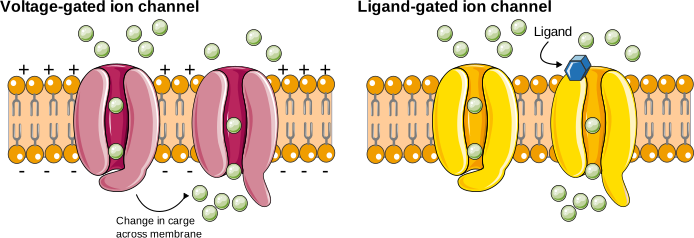
Voltage-gated channels open and close in response to membrane potential. They are central to excitability in neurons, heart, and muscle. Cryo-EM has enabled direct mapping of drug binding sites in human sodium channels, illustrating how chemically different scaffolds can engage distinct pockets and sometimes distinct numbers of sites on a single channel. [11]
Figure 1: Mechanistic overview of Voltage-gated ion channels (Left) and Ligand-gated ion channels (right).
Drug discovery implications: state dependence, kinetics (on/off rates), subtype selectivity, and tissue distribution often dominate feasibility. For example, sodium channel drug discovery programs frequently aim for use-dependent inhibition in hyperexcitable tissue while minimizing effects in normal physiology.
Ligand-gated ion channels (GABAA, nAChR, glutamate receptors, P2X)
Ligand-gated channels convert chemical neurotransmitters into fast electrical signals. A major practical challenge is that subunit composition can change pharmacology: the “same” receptor family can exist in many assemblies with distinct binding pockets and functional outcomes.
Recent work isolating native GABAA receptor assemblies and solving structures bound to clinically relevant drugs provides a vivid example of how real-world pharmacology depends on receptor composition and state. [9]
TRP channels (TRPV1, TRPA1, TRPM8, etc.)
Transient Receptor Potential (TRP) channels integrate temperature, inflammation, and chemical signals. A recent review describes how TRP channel drug discovery has expanded beyond pain into respiratory, metabolic, and neuropsychiatric diseases as well as oncology-relevant biology, while also underscoring translational pitfalls (e.g., on-target thermoregulation issues in some TRPV1 programs). [8]
CFTR and the power of “channel modulators”
Cystic Fibrosis Transmembrane Conductance Regulator (CFTR) is a clinically transformative case story for ion channel modulation. A study showing high-resolution structural work showed how components of triple-combination therapy bind CFTR and synergistically rescue folding and/or function in the ΔF508 context. [10]
Takeaway: channels often require mechanism-specific and sometimes multi-ligand strategies. That reality should influence how you design screening cascades and hit-to-lead plans.
What makes ion channel drug discovery particularly challenging?
Ion channel programs rarely fail because the target is “not relevant.” More often, they fail because connecting binding → functional effect → therapeutic window is harder than expected.
1) State-dependent binding and the “moving target” problem
Channels change conformation during gating. A compound can bind preferentially to one state, leading to strong effects under some protocols and weak effects under others. Structural mapping of Nav1.7 antagonists provides concrete evidence: multiple chemotypes bind different sites and stabilize different states meaning your assay protocol can determine what you see. [11]
Practical takeaway: define the desired state dependence early (e.g., tonic vs use-dependent inhibition) and ensure the screening cascade measures that property (not just “any inhibition”).
2) Translating binding into functional modulation
A binder is not automatically a blocker or opener. Functional consequence depends on:
- binding site (pore vs allosteric pocket),
- kinetics and residence time,
- state preference,
- membrane access / partitioning,
- and biological system (cell type, auxiliary subunits, lipid composition).
This is why mature discovery programs treat ion channel binding assays and functional assays as complementary rather than competing.
3) Selectivity and safety are inseparable
Channel families can be conserved, and off-target channel activity can create safety concerns. This is one reason automated electrophysiology platforms became prominent in cardiac safety assessment and late-stage profiling. [6]
4) Assay constraints and throughput limitations
The classic patch clamp paper (Hamill et al.) captures why electrophysiology is so powerful – and implicitly why it has historically limited throughput. [3] Automated patch clamp has improved scale and standardization but remains a more intensive modality than most plate-based assays or pooled binding selections. [4]
Ion channel screening technologies: what each approach is good for
Manual patch clamp: maximal information, minimal throughput
Manual patch clamp provides:
- precise voltage protocols,
- detailed kinetics,
- mechanistic interpretation (block vs gating shifts),
- and high-confidence data.
It is still the benchmark for many channel decisions. [3]
Automated patch clamp: scalable electrophysiology (with practical constraints)
Automated patch clamp (APC) boosts throughput and reduces operator variability. Reviews of APC innovation describe how it has become standard in many organizations for lead optimization and safety profiling. [4,6]
Where APC is strongest:
- confirming functional activity of prioritized hits,
- running SAR efficiently once you have a tractable series,
- safety panels (depending on program needs).
Fluorescence/flux and membrane potential assays: fast functional proxies
Plate-based assays can screen larger compound sets quickly. A review of high-throughput ion channel screening technologies summarizes the major categories: Binding assays, flux-based assays, fluorescence-based assays, and automated electrophysiology flowed by how they map to different channel classes. [5]
Common pitfalls: indirect readouts, coupling artifacts, and off-target effects. These assays are extremely useful, but they demand careful controls and orthogonal validation.
Ion channel binding assays: “does it bind?” still matters
Binding assays can feel less fashionable than functional assays, but for channels they remain strategically useful, especially in early phases of drug discovery.
Why binding assays matter in practice:
- triaging functional assay artifacts (is it direct channel binding or pathway interference?)
- mapping competition vs known ligands (where tracers exist)
- supporting selectivity strategies
- and enabling nonfunctional ion channel ligand discovery (binder-first programs)
Importantly, binding assays can be deployed in multiple formats (radioligand displacement, SPA, filtration, and in some cases biophysical approaches when target presentation allows). The best format depends on channel class, available ligands, and how the target is prepared.
Modern hit-finding strategies for ion channel ligand discovery
There isn’t a single “best” approach to ion channel ligand discovery. Most successful programs mix methods across stages.
1) Classic small-molecule HTS (functional or binding-based)
If you have a robust plate assay or scalable APC, HTS can deliver hits quickly. The challenge is often what happens next: HTS hits can cluster into liabilities (promiscuity, low solubility, poor permeability) and may require significant triage before electrophysiology.
2) Fragment-based discovery (FBDD)
Fragments can be effective if you measure binding reliably and/or have strong structural biology. For channels, feasibility often hinges on target presentation and assay sensitivity.
3) Structure-enabled design (cryo-EM-guided)
Cryo-EM has changed ion channel medicinal chemistry by making binding pockets visible and enabling rational analog selection. Reviews of voltage-gated channels highlight this shift, emphasizing how structures can explain pharmacology and guide optimization. [1]
Concrete examples include:
- Nav1.7 structures with diverse antagonists and lead compounds [11]
- Native GABAA receptor assemblies bound to clinically used drugs [9]
- CFTR modulator binding that clarifies synergy in triple therapy [10]
4) In silico screening and AI-assisted prioritization
Virtual screening can reduce experimental burden, but outcomes depend on the accuracy of the target model and whether you’re docking into the relevant state. For channels where state dependence dominates, computational work often performs best as a prioritization layer rather than the sole discovery engine.
5) Biologics and alternative modalities (beyond small molecules)
Small molecules dominate ion channel pharmacology because many clinically relevant pockets are in the pore domain or allosteric sites not easily accessed by large biologics. Still, there is an emerging landscape of antibodies targeting ion channels, largely aimed at extracellular epitopes for specific mechanisms. A detailed review discusses the opportunities and technical challenges of ion-channel-targeting antibodies. [12]
Why mention this on a small-molecule page?
Because it reflects a broader industry trend: teams increasingly pursue multiple modalities in parallel when classic small molecules struggle. Even if your program is small-molecule-led, understanding the modality landscape helps sharpen differentiation and risk planning.
Target presentation: the make-or-break detail for ion channel screening
How do you present the channel in a way that preserves relevant structure and pharmacology?
Cell-based presentation (native or engineered)
Cell-based systems preserve membrane environment and (often) native assembly. They enable direct functional assays and can support certain target-engagement approaches. The trade-off is complexity: background binding, expression variability, and cell-specific effects can complicate interpretation.
Purified protein in detergent or nanodiscs
Purified channels can enable cleaner biochemical and biophysical work, but detergents may destabilize or bias conformations. Nanodiscs and related membrane mimetics aim to preserve a more native-like lipid environment.
Two recent reviews provide accessible entry points:
- Nanodiscs for the study of membrane proteins (overview of nanodisc platforms and applications) [13]
- Nanodiscs in membrane protein drug discovery and development (focus on drug discovery applications and workflows) [14]
Practical point: Most ion channel programs use multiple formats over time: Cell-based for physiological relevance and purified/nanodisc formats for mechanistic binding or structure efforts when feasible.
DNA-Encoded Library (DEL) screening as one route to ion channel ligand discovery
DEL is best understood as a binder discovery engine: a way to identify ligands by affinity selection from exceptionally large chemical libraries, followed by off-DNA resynthesis and validation. A comprehensive review describes how DEL libraries are built, screened, and analyzed, and why they can deliver rapid access to “early chemical matter.” [15]
Why DEL can be useful for ion channels
Ion channels can be bottlenecked by functional assay throughput. DEL can help by shifting the earliest step “find starting matter” toward a pooled, binding-based workflow. That enables:
- rapid early hit identification for ion channels across diverse chemotypes,
- efficient exploration of chemical space with low target consumption,
- and nonfunctional ion channel ligand discovery when you need binders first and mechanism later.
This is especially attractive when you have strong genetic/biological rationale but limited chemical starting points.
Live-cell and in-cell selection methods: why they matter for membrane proteins
Historically, DEL selections were most common on purified proteins. However, the field has advanced to include selections in a cellular context:
- A Nature Chemistry paper reported a method enabling DEL selections against endogenous membrane proteins on live cells without overexpression by DNA-tag labeling of the membrane protein. [16]
- A JACS study reported screening a multimillion-member DEL inside a living cell (Xenopus oocyte-based), demonstrating feasibility of in-cell selections which could potentially lead to the discovery of intracellular ion channel modulators. [17]
These developments are relevant to ion channels because native membrane context and assembly can strongly influence which ligands bind productively.
“Binding-first” doesn’t mean “function-last”
A healthy ion channel discovery cascade treats DEL as a front end:
- DEL selection →
- off-DNA resynthesis →
- orthogonal confirmation (binding and/or cellular engagement) →
- functional follow-up (patch clamp/APC and/or plate assays) →
- iterative SAR.
That flow is consistent with how many organizations allocate resources: run expensive electrophysiology on chemistry that has already “earned” deeper investment.
A practical workflow for ion channel programs (broad, realistic, and scalable)
Below is a pragmatic discovery flow that works whether your entry point is HTS, structure-based design, fragments, or DEL.
Step 1: Define the therapeutic hypothesis and desired mechanism
Be explicit about:
- blocker vs modulator vs opener,
- tonic vs use-dependent behavior,
- desired kinetics (fast/slow onset, long/short residence),
- key safety concerns and counterscreens.
This prevents the common failure mode of optimizing potency in an assay that does not reflect the desired mechanism.
Step 2: Choose an entry strategy based on constraints
- Robust plate assay available? HTS can be efficient for initial hit-finding.
- Structural data strong? Structure-guided libraries and rational analog selection may be faster than brute-force screening.
- Electrophysiology bandwidth limited? Consider binder-first strategies (including DEL screening) to generate chemical matter before deep functional investment.
The “right” answer often changes over time as you learn more about the target and the assay landscape.
Step 3: Confirm hits with orthogonal assays
For ion channels, orthogonal confirmation is not bureaucracy its survival:
- confirm direct target engagement, if possible,
- use at least one independent functional format when feasible (e.g., flux assay + patch clamp),
- counter-screen early against close homologs or liabilities relevant to the indication.
Step 4: Deploy electrophysiology strategically
Use patch clamp and APC to answer questions that other assays can’t:
- state dependence,
- gating shifts,
- kinetics/residence,
- protocol-relevant behavior that triggers physiological patterns.
APC reviews emphasize how electrophysiology scale has improved – but also why it still benefits from strong upstream triage. [4,6]
Where Vipergen fits (in a broader ion channel discovery story)
Vipergen focuses on DNA-encoded library technology, including workflows designed for challenging targets such as membrane proteins and receptors. Vipergen’s technology overview describes three components: YoctoReactor® (DEL creation), Binder Trap Enrichment® (BTE; homogeneous DEL screening), and Cellular Binder Trap Enrichment® (cBTE) for screening DELs inside living cells. [19,20]
For ion channel programs, that can be most relevant when:
- You want ion channel ligand discovery and small molecule ion channel binders early, before committing heavy electrophysiology resources.
- Your channel is difficult to purify or loses native pharmacology outside the membrane,
- You want a binder-first route to early hit identification for ion channels, feeding your functional cascade.
Vipergen also describes DEL screening services for purified biotinylated integral membrane proteins formulated in nanodiscs or detergent, which can be useful when you have a stable purified channel construct and want controlled binding selections. [21]
Conclusion: ion channel success comes from integration – not a single “best” technology
Ion channels remain among the most clinically impactful and scientifically demanding drug targets. The combination of state-dependent conformations, membrane biology, and assay constraints means that success usually comes from an integrated strategy:
- Use the right ion channel screening technologies for the question at hand (functional vs binding vs structure).
- Treat ion channel binding assays as a practical way to reduce artifacts and anchor mechanism.
- Deploy electrophysiology (manual or automated) where it delivers decisive information.
- Use pooled binder discovery methods (including DNA encoded library ion channel screening) when early chemical matter is the limiting factor – especially for nonfunctional ion channel ligand discovery and rapid early hit identification for ion channels.
In practice, this integrated mindset is what turns ion channels from a challenge into a manageable, repeatable discovery workflow.
References
[1] Huang J, Pan X, Yan N. Structural biology and molecular pharmacology of voltage-gated ion channels. Nat Rev Mol Cell Biol (2024), 25 (11), 904-925. https://doi.org/10.1038/s41580-024-00763-7
[2] Bagal SK et al. Ion Channels as Therapeutic Targets: A Drug Discovery Perspective. J Med Chem (2013), 56, 3, 593-624. https://pubs.acs.org/doi/10.1021/jm3011433
[3] Hamill OP et al. Improved patch-clamp techniques for high-resolution current recording from cells and cell-free membrane patches. Pflügers Arch (1981), 391 (2), 85-100. https://link.springer.com/article/10.1007/BF00656997
[4] Obergrussberger A et al. Automated patch clamp in drug discovery: major breakthroughs and innovation in the last decade. Expert Opin Drug Discov (2021), 16 (1), 1-5. https://doi.org/10.1080/17460441.2020.1791079
[5] Yu H et al. High throughput screening technologies for ion channels. Acta Pharmacol Sin (2015), 37 (1), 34-43. https://doi.org/10.1038/aps.2015.108
[6] Bell DC, Fermini B. Use of automated patch clamp in cardiac safety assessment: past, present and future perspectives. J Pharmacol Toxicol Methods (2021), 110, 107072. https://doi.org/10.1016/j.vascn.2021.107072
[7] Santos R et al. A comprehensive map of molecular drug targets. Nat Rev Drug Discov (2017), 16 (1), 19-34. https://doi.org/10.1038/nrd.2016.230
[8] Koivisto A-P et al. Advances in TRP channel drug discovery: from target validation to clinical studies. Nat Rev Drug Discov (2022), 21 (1), 41-59. https://doi.org/10.1038/s41573-021-00268-4
[9] Sun C et al. Cryo-EM structures reveal native GABAA receptor assemblies and pharmacology. Nature (2023), 622, 195-201. https://doi.org/10.1038/s41586-023-06556-w
[10] Fiedorczuk K, Chen J. Molecular structures reveal synergistic rescue of Δ508 CFTR by Trikafta modulators. Science (2022), 378 (6617), 284-290. https://doi.org/10.1126/science.ade2216
[11] Wu Q et al. Structural mapping of Nav1.7 antagonists. Nat Commun (2023), 14 (1), 3224. https://doi.org/10.1038/s41467-023-38942-3
[12] Hutchings CJ et al. Ion channels as therapeutic antibody targets. MAbs (2019), 11 (2), 265-296. https://doi.org/10.1080/19420862.2018.1548232
[13] Denisov IG et al. Nanodiscs for the study of membrane proteins. Curr Opin Struct Biol (2024), 87, 102844. https://doi.org/10.1016/j.sbi.2024.102844
[14] Dong Y et al. The application of nanodiscs in membrane protein drug discovery & development and drug delivery. Front Chem (2024), 12, 1444801. https://doi.org/10.3389/fchem.2024.1444801
[15] Gironda-Martínez A et al. DNA-Encoded Chemical Libraries: A Comprehensive Review with Succesful Stories and Future Challenges. ACS Pharmacol Transl Sci (2021), 4 (4), 1265-1279. https://doi.org/10.1021/acsptsci.1c00118
[16] Huang Y et al. Selection of DNA-encoded chemical libraries against endogenous membrane proteins on live cells. Nat Chem (2021), 13 (1), 77-88. https://doi.org/10.1038/s41557-020-00605-x
[17] Petersen LK et al. Screening of DNA-Encoded Small Molecule Libraries inside a Living Cell. J Am Chem Soc (2021), 143, 7, 2751-2756. https://doi.org/10.1021/jacs.0c09213
[18] Blakskjaer P et al. Fidelity by design: YoctoReactor and binder trap enrichment for small-molecule DNA-encoded libraries and drug discovery. Curr Opin Chem Biol (2015), 26, 62-71. https://doi.org/10.1016/j.cbpa.2015.02.003
[19] Vipergen website: Technology overview (YoctoReactor®, BTE®, cBTE®). https://www.vipergen.com/technology/
[20] Vipergen website: Cellular Binder Trap Enrichment® (cBTE). https://www.vipergen.com/cellular-binder-trap-enrichment/
[21] Vipergen website: DEL – Integral Membrane Proteins (nanodiscs/detergent). https://www.vipergen.com/del-integral-membrane-proteins/
[22] Vipergen website: Understanding DEL Screening: From Target Binding to Hit Validation. https://www.vipergen.com/understanding-del-screening-from-target-binding-to-hit-validation/