


| Service | Best for | You provide | Turnaround | Output |
|---|---|---|---|---|
| DEL Snap | Fast, affordable early lead; startups | Biotinylated protein | 20 business days | Structures for top 25 hits |
| DEL Express | Tractable target, purified protein in hand | Biotinylated protein | 20 business days | Hit list + structures |
| DELs in Cells Snap | Fast, affordable early lead; startups | Amino acid sequence | 40 business days | Structures for top 25 hits |
| DELs in Cells Express | Tractable target, no purified protein in hand | Amino acid sequence | 30 business days | Hit list + structures |
| Custom DEL screen | Difficult targets such as molecular glue, PPI, TF, and membrane proteins | Purified target protein(s) | Bespoke | Full campaign and full dataset |
| Custom DEL in Cells screen | Difficult targets such as molecular glue, PPI, TF, and membrane proteins | Amino acid sequence(s) | Bespoke | Full campaign and full dataset |
Why Choose Vipergen for DEL-Based Drug Discovery Services
Vipergen is built for fast, high confidence hit discovery, also when targets are challenging or timelines are tight:
- High-fidelity libraries (yoctoReactor): Libraries are constructed without truncates and with 100% barcode-to-compound correspondence, improving downstream hit validation rates.
- Massive drug-like chemical space: Each of our libraries contains 500+ million drug-like molecules, which are screened in single experiments.
- Multiple screening formats: BTE for homogeneous in vitro selections and cBTE for screening DELs inside living cells.
- Reduced barriers to entry: cBTE removed the need for highly purified target protein and broadens target space.
- Proven expertise: Specialized in DNA-encoded library synthesis and screening since 2005.
- Actionable outputs: Ranked hits with chemical structures plus data designed to accelerate medicinal chemistry decisions.
Commercial models & IP at a glance
Commercial models:
We offer flexible engagement structure to match your program needs:
- Fee-for-Service (standard): DEL Screening with optional off-DNA resynthesis
- Collaborative models: for extended hit-to-lead partnerships (where appropriate)
IP & Ownership (summary)
- Your program results: We aim for clear client ownership of program-specific data and validated compounds generated for your target.
- Vipergen background IP: Vipergen retains background IP related to our platform technologies, library design, and methods
- Client foreground IP: Client owns all foreground IP for nominated chemical series with no downstream financial obligations
Pricing & scope transparency
To make scoping easy, we quote using packaged deliverables + clear options:
- Base scope: feasibility study → DEL selection(s) and analysis to generate hit list
- Optional modules includes: off-DNA resynthesis, selectivity screens, and hit-expansion
Drug Discovery Process Overview: From Target to Preclinical Development
This drug discovery process overview breaks the drug discovery cycle into four connected stages each with different risks, costs, and decision points:
- Target identification & validation: Early evidence that modulating a target can produce the desired biology. DEL-derived chemical matter can support validation by enabling direct target engagement studies.
- Hit identification: Rapidly find binders/modulators against your target at scale—this is where Vipergen’s DEL screening delivers the biggest time and resource advantage.
- Lead identification & optimization: Build confidence by confirming hits off-DNA, expanding SAR, and improving potency/selectivity toward a viable lead series.
- Preclinical development: Candidate selection, PK/PD, safety, and developability packages.
Vipergen accelerates hit identification and early hit-to-lead by pairing high-fidelity libraries with selection formats that match the biology (in vitro or in living cells).
DEL Screening Services for Hit Identification
Accelerating Hit Identification with DELs
DEL screening compresses early hit identification by enabling compound screening in drug discovery at massive scale, by testing hundreds of millions of DNA-barcoded small molecules in a pooled format and decoding binders by sequencing. This approach reduces reagent consumption and accelerates the drug discovery workflow compared with conventional HTS.
Early drug discovery is the initial stage of the preclinical drug development process where a biological target first needs to be identified and evaluated. Following this, compound collections or chemical libraries are screened to identify novel hit compounds. The early-stage drug discovery process should ideally, after lead optimization, result in preclinical candidates. Traditionally, identifying such molecules could take years of research and vast amounts of resources.
Vipergen’s DNA Encoded Libraries (DELs) accelerate this process by enabling the screening of millions of small molecules encoded with DNA barcodes. DEL screening accelerates hit identification, significantly reducing the time and cost associated with early-stage drug discovery. Unlike conventional high-throughput screening (HTS), which often demands large-scale resources, DEL screening is conducted in a single test tube or even directly in living cells. This breakthrough methodology enhances efficiency, minimizes resource consumption, and streamlines the discovery of promising drug candidates.
DEL Screening Formats (in vitro and in living cells)
- In vitro selections (BTE): A homogeneous DEL screening approach that traps ligand–target complexes in emulsion droplets, preserving binding information for sequencing-based identification.
- In cell selections (cBTE): A platform for screening DELs inside living cells, enabling physiologically relevant target engagement with no need for highly purified target protein and broader target space.
Utilizing in vitro DEL screening might be difficult with:
- Hard-to-express or purify protein, where aggregations, low yield or mis-folding make it difficult to obtain milligram quantities of pure protein.
- Membrane-embedded proteins, where detergent micelles or nanodiscs are required to keep the target folded. This can mask binding sites and add background DNA stickiness.
- Allosteric or conformationally dynamic targets where buffers and detergents disrupt conformation.
- Proteins where post-translational modifications are important for function.
- Lipid dependent targets, where detergents can mask binding sites.
In these cases, utilizing Vipergen’s cellular Binder Trap Enrichment (cBTE) is a good option for a better return on investment.
Targets we support
What you receive
At the end of a screen, you receive a prioritized, decision-ready package designed to accelerate follow-up work:
- Ranked hit structures and series grouping
- Enrichment metrics (selection performance and confidence indicators)
- Early SAR signals when available from library and analog coverage
- Clear go/no-go recommendations and next-step options (confirmation, resynthesis, SAR expansion)
Custom feasibility assays
Vipergen DEL Screening Workflow: From Target to Validated Hits
- Feasibility
- Selection design (controls, stringency, libraries, competition etc.)
- DEL selection against your target
- NGS readout and computational analysis
- Hit triage (series clustering, liability checks, resynthesis planning)
- Off-DNA resynthesis (optional)
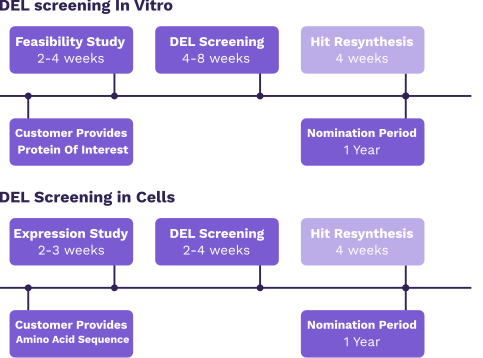
Figure 1: Approximate timeline for DEL screening in vitro (top) or in cells (bottom). All timeframes are approximate and scales with number of screening slots, and quantity of hit resynthesis.
Lead Optimization in Drug Discovery: Hit-to-Lead Support
Use DEL data to accelerate SAR
Vipergen libraries are designed to return early SAR by including analogs and stereochemical variants—helping teams identify which substituents and exit vectors drive binding and which regions tolerate change. This reduces guesswork and focuses medicinal chemistry on the most promising series earlier.
Off-DNA resynthesis
To progress from “DNA hit” to “project-ready lead series,” Vipergen can support off-DNA hit resynthesis of selected hits.
Supporting complex modalities (bivalent, PROTACs)
DEL-derived binding series can reveal anchor points (chemically tractable positions for linker attachment), supporting rational design of bivalent molecules such as PROTACs recruitment handles during hit-to-lead
Medicinal chemistry support + informatics
Key Technologies and Methodologies
yoctoReactor® high-fidelity DEL synthesis
Vipergen’s yoctoReactor® enables DEL construction without truncates, delivering a 100% match between barcode and displayed small molecule. High-fidelity libraries reduce false positives and improve downstream hit validation and off-DNA resynthesis efficiency.
Library design, scale, and “why it matters”
BTE® and cBTE® selection platforms
- BTE® is a homogeneous screening method that isolates ligand–target complexes in droplets to preserve binding information for sequencing-based identification.
- cBTE® enables DEL screening inside living cells under physiologically relevant conditions, broadening target space and reducing reliance on purified protein.
Benefits of Outsourcing DEL-Based Drug Discovery Services
Outsourcing early discovery to a specialized DEL drug discovery services partner helps teams reduce fixed costs and accelerate decisions:
- Cost and resource efficiency: Pooled DEL selection reduces plate-based reagent consumption and assay overhead compared with traditional screening.
- Faster timelines: Vipergen delivers qualified hits in weeks instead of months, accelerating early pipeline decisions.
- Access to specialized platforms: High-fidelity yoctoReactor® libraries plus BTE®/cBTE® screening formats are difficult to replicate in-house quickly.
- Risk mitigation: Physiologically relevant in-cell screening can reduce attrition by identifying binders that engage the target in a cellular context.
Drug Discovery for Startups: DEL Screening Without a Lab
Thanks to venture funding and virtual-first operating models, a small team startup can now pursue targets that once required Big Pharma resources. Yet the gap between an exciting biology hypothesis and a pre-clinical candidate is still daunting – especially if you have limited access to laboratory space. DNA encoded library (DEL) screening offers a capital-efficient path forward. By partnering with specialized drug discovery service providers such as Vipergen, young companies can access multi-million-member libraries and extensive hit-finding expertise without leasing bench space.
A startup-friendly path: DELs in Cells – Snap
Fit with limited laboratory space for the startup
Vipergen operates as a DEL-as-a-service platform. You supply the protein or amino acid sequence for in vitro and in cell screening respectively. From here Vipergen performs the DEL screening and analysis before providing a report including hit lists with chemical structure information. For distributed teams, academic spinouts or startups, DEL screening could be the first outsourced step in the drug discovery process. Further Vipergen can assist with off-DNA hit resynthesis.
Choosing a DEL Screening Partner: Questions and Answers
Use the checklist below to evaluate any DEL CRO or partner. If you’d rather walk through it together, Vipergen scientists can review your target, constraints, and ideal readouts and recommend the best screening format and follow-up path.
Look for rigorous QC and clear claims on fidelity (Vipergen: yoctoReactor® libraries are built without truncates and maintain 100% barcode-to-compound correspondence).
Favor partners who maximize biologically relevant diversity (Vipergen: 500+ million drug-like molecules per library screened in one experiment).
Vipergen have developed a Snap platform, where we have made it easy, fast and affordable to get an early lead.
We support Fee-for-Service projects (Feasibility study, DEL screening, and optional off-DNA resynthesis) and can also consider collaborative partnerships for programs that require deeper joint work.
In Fee-for-Service projects, we typically structure agreements so clients have clear rights to program-specific results (data packages and synthesized compounds generated for the client’s target).
No, once clients nominate chemical series identified from the DEL screens performed clients owns all foreground IP without any downstream financial obligations.
DEL – Express, 20 business days.
Custom cBTE is one of our specialties. See our intracellular screening services for molecular glues, PPI inhibitors, membrane proteins, and other hard-to-drug-targets.
Snap is built to be fast and affordable, and you keep the IP.
Successful Drug Discovery with Vipergen
Vipergen has successfully partnered with leading pharmaceutical and biotech companies to accelerate drug discovery. Our case studies highlight:
- Rapid hit identification – Reducing discovery timelines from years to months.
- Novel target engagement – Enabling drug development for previously undruggable targets.
- Efficient lead optimization – Providing high-quality leads with optimized properties.
Explore Vipergen’s Full Range of Drug Discovery Services
Vipergen offers a comprehensive suite of drug discovery services, from early hit identification to lead optimization. Explore our advanced screening technologies and innovative solutions designed to accelerate drug development.
About Vipergen
Vipergen is a Copenhagen-based drug discovery services provider focused on DEL technologies, including platforms for screening DELs in vitro and inside living cells. We apply rigorous library design and quality controls—including high-fidelity synthesis approaches that eliminate truncates—to improve the reliability of hit identification and downstream validation.
Read our published cBTE protocol here.